Best Generator for Camping: How to Choose the Right Power Source
We may earn a commission for purchases made using our links. Please see our disclosure to learn more.
A dead phone is inconvenient at home; at camp, it can mean losing your map, weather alerts, or emergency contact. Add a portable fridge, CPAP machine, lights, camera batteries, or an RV appliance, and choosing a generator for camping becomes a practical power decision rather than a simple gadget purchase. Wattage labels, battery capacity, fuel choices, noise ratings, and outlets can make shopping confusing.
This guide explains how to estimate your needs, compare power types, avoid serious safety mistakes, and choose from six options for different campers and trip styles.
The right choice should cover your essentials without hauling more weight, fuel, or battery than necessary.
What a Generator for Camping Should Actually Power
List the equipment you genuinely expect to use. Phones, LED lanterns, and cameras need little power. A portable refrigerator, coffee maker, CPAP machine, microwave, or RV appliance changes the calculation.
Separate essentials from conveniences, note runtime, and decide which devices must operate together. Your generator for camping must handle their combined running load and startup surge—not merely the largest appliance.
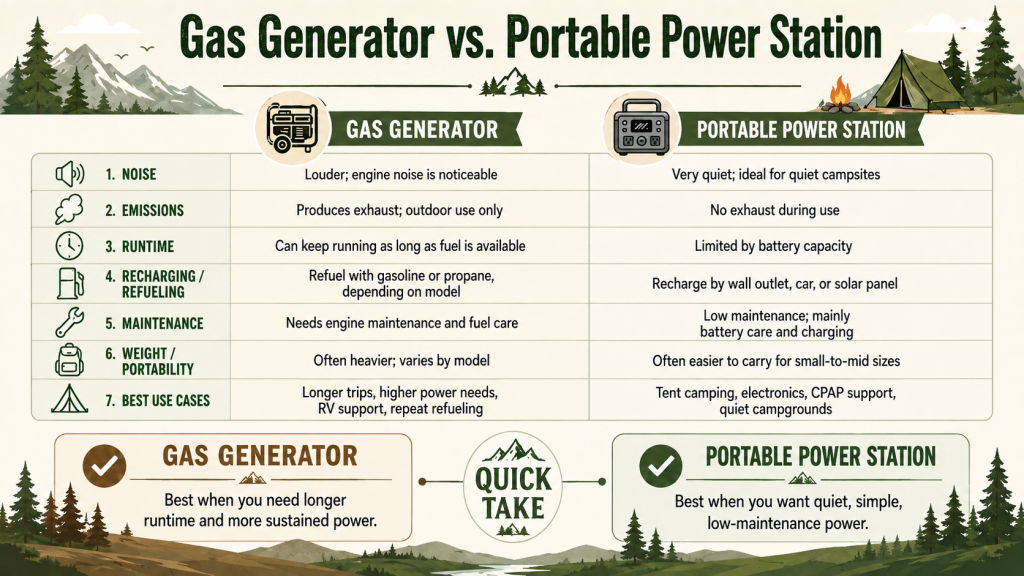
Gas Inverter Generator vs. Portable Power Station
A gas or dual-fuel inverter generator creates power while its engine runs. It suits longer trips and repeat refueling, but it produces exhaust, needs maintenance, and may face campground restrictions.
A portable power station stores electricity silently but must be recharged after depletion. Campers considering battery power can compare portable power stations for camping before choosing capacity.
Battery models suit quiet trips; fuel models help when sustained power matters more than charging access.
How Many Watts Does a Generator for Camping Need?
Check each device’s official specifications. Record running watts, starting watts for motor-driven equipment, and the combined load used simultaneously.
A fridge using 60 watts, CPAP using 50, lights using 20, and chargers using 80 creates a 210-watt running load. Leave headroom, and add battery capacity for conversion losses, poor weather, and unexpected charging.
Running Watts, Starting Watts, and Watt-Hours
Running watts describe continuous output. Starting or surge watts cover the brief demand when a compressor, pump, or motor switches on.
Watt-hours measure stored energy. A 1,000Wh battery theoretically supports 100 watts for ten hours, though real runtime is lower.
A power station may start an appliance yet lack capacity for long use. Match maximum demand and total energy.

Noise Levels and Campground Rules
Enclosed inverter generators are usually quieter than open-frame designs, but manufacturer ratings use specific loads and distances. Compare like with like.
Rules vary by campground. Yosemite’s campground regulations, for example, permit generators only during three daily time blocks, while some campground loops elsewhere prohibit them. Check the current rules attached to your reservation.
Reduce disturbance by using level ground and keeping vibration away from tables, vehicles, and platforms.
Fuel, Runtime, and Recharging a Generator for Camping
Gasoline is widely available but can spill and degrade. Propane stores in a sealed cylinder, though generators often produce fewer watts on it. Dual-fuel models add flexibility.
Published runtimes usually reflect a particular load, so use them for comparison rather than as guarantees.
For battery stations, compare wall, vehicle, and solar charging. Because shade, clouds, and panel angle reduce solar production, carry enough energy for imperfect conditions.
Generator for Camping Portability, Outlets, and RV Compatibility
Consider the route from vehicle to campsite, not only listed weight. Handles, dimensions, gravel, and steps affect portability.
Match the outlets to your equipment. Tent campers may value USB-C and household receptacles. RV owners may prefer a TT-30R outlet, but plug shape does not increase the generator’s available wattage.
Covered outlets, clear displays, overload protection, and accessible controls make setup easier in poor weather or darkness.
Research-Backed Generator for Camping Safety
Carbon monoxide is colorless, odorless, and potentially fatal. The CDC’s 2026 carbon-monoxide guidance says to operate portable generators outdoors, more than 20 feet from windows, doors, and vents. Apply that separation to tents, RV openings, cabins, and neighboring sites.
The U.S. Consumer Product Safety Commission’s generator guidance also says to direct exhaust away from occupied spaces and use working carbon-monoxide alarms. An automatic CO shutoff feature never replaces correct placement.
OSHA’s portable-generator guidance advises keeping generators dry, using grounded cords rated for the anticipated load, avoiding overloads, and shutting the engine down before refueling. These recommendations address carbon-monoxide, electrical, and fire hazards—not performance.
Best Generator for Camping: Recommended Products
The best generator for camping depends on whether you prioritize battery power, easy lifting, dual-fuel flexibility, RV connections, or long-term ownership.
| Product | Type | Key specification | Best match |
| Honda EU2200i | Gas inverter | 1,800W rated | Premium ownership |
| WEN 56203i | Gas inverter | 1,700W rated | Lower budget |
| Champion 201183 | Dual-fuel | 1,850W gas rated | Fuel flexibility |
| Westinghouse iGen2550DFc | Dual-fuel | 1,900W gas rated | Small RVs |
| Jackery Explorer 1000 v2 | Battery | 1,070Wh; 1,500W | Quiet portability |
| EF ECOFLOW DELTA 2 | Battery | 1,024Wh; 1,800W | Higher AC output |
Honda EU2200i Super Quiet Inverter Generator with CO-MINDER
Best for: Campers prioritizing refined operation and long-term ownership
The EU2200i supplies 1,800 rated watts and 2,200 maximum watts, weighs 47.4 pounds, and includes Honda’s CO-MINDER shutdown system. Its published 48-to-57 dBA range suits noise-conscious camping better than an open-frame design. The main consideration is cost: occasional, low-power campers may not need its premium positioning.
WEN 56203i Super Quiet 2000-Watt Portable Inverter Generator with Fuel Shut Off
Best for: Budget-minded tent campers and occasional users
This 39-pound inverter generator delivers 1,700 rated watts and 2,000 surge watts. Fuel shutoff lets the engine consume fuel remaining in the carburetor before storage, simplifying seasonal care. It also provides household, 12-volt, and USB connections, although its lower output leaves less room for several high-draw appliances.
Champion Power Equipment 2500-Watt Dual Fuel Ultralight Portable Inverter Generator with Quiet Technology and CO Shield
Best for: Campers who want gasoline and propane flexibility
Champion’s model 201183 runs on gasoline or propane, weighs 39 pounds, and provides 1,850 running watts on gasoline. CO Shield adds automatic carbon-monoxide shutoff, while parallel capability allows future expansion. Propane output is lower, so calculate loads using the specification for the fuel you will actually carry.
Westinghouse iGen2550DFc Dual Fuel Inverter Generator with CO Sensor
Best for: Small-RV campers wanting a built-in 30-amp RV outlet
The iGen2550DFc provides 1,900 running watts on gasoline or 1,700 on propane. Its TT-30R receptacle, household outlet, USB ports, CO sensor, and 43.2-pound weight form a practical RV-focused package. However, a 30-amp-style outlet does not mean the generator supplies the full output of a 30-amp campsite pedestal.
Jackery Explorer 1000 v2 Portable Power Station
Best for: Quiet campsites, tent use, and easy carrying
This LiFePO4 power station has a capacity of 1,070Wh and a rated AC output of 1,500 watts. It weighs approximately 23.8 pounds. It can run electronics and modest appliances without engine noise or fuel handling. Its limitation is finite energy: refrigeration, heating appliances, and poor solar conditions can drain it faster than expected.
EF ECOFLOW Portable Power Station DELTA 2
Best for: Campers wanting stronger AC output from a mid-size battery
The DELTA 2 pairs a 1,024Wh LiFePO4 battery with 1,800 watts of AC output and several charging methods. That output supports more appliances than many similarly sized stations. Still, capacity remains close to one kilowatt-hour, so high-watt cooking or heating devices can shorten runtime dramatically despite the capable inverter.
How to Match a Generator to Your Camping Style
Tent campers should prioritize quiet operation, low weight, and capacity for essentials. Battery stations are often easier when recharging between trips.
For multi-day camping, fuel power offers repeatable energy when you can transport fuel and maintain safe placement.
Small-RV owners should calculate actual appliance loads rather than buying by outlet shape. Medical-device users should also confirm power draw, humidifier use, backup duration, and manufacturer instructions before relying on one source.
Where to Set Up a Generator for Camping
Use a dry, level surface where exhaust cannot drift toward tents, RVs, vehicles, or cabins. Maintain more than 20 feet of separation and consider wind. Never run it under an awning, inside a vestibule, beneath an RV, or in a vehicle.
Route undamaged outdoor-rated cords away from feet, tires, and puddles. Never use a cover that traps heat or exhaust.
Battery stations avoid exhaust, but they still need ventilation and protection from rain, loose dirt, and direct heat.
Maintenance and Storage Between Trips
Follow the fuel generator’s manual for oil, filters, spark plugs, fuel treatment, carburetor care, and storage. Before leaving the house, make sure it works properly. Keep fuel in approved containers away from living areas, and never refuel a hot engine.
For a battery station, follow the recommended storage charge and recharge interval. Keep it within the listed temperature range and inspect cables before travel. Battery care is cleaner, but long periods at zero charge can still reduce usefulness.
Buying Mistakes That Waste Money
Do not shop by peak wattage alone. Rated output determines sustained power, while battery capacity determines runtime.
“Quiet” does not mean permitted everywhere. Check generator hours, outlet compatibility, cord requirements, weight, and service support.
Do not plan around ideal solar production or average consumption without allowing for heat and startup surges. The smartest generator for camping solves your normal trip with a reasonable reserve—not an imaginary campsite running every appliance at once.
Generator for Camping FAQs
What size generator for camping do I need?
For phones and lights, a small battery station may work. Refrigerators, CPAP machines, coffee makers, and RV appliances require a calculation. Add simultaneous running watts, identify the largest starting surge, and leave extra capacity. With battery models, estimate daily watt-hours as well as output watts.
Can I use a generator at night in a campground?
Often, no. Many campgrounds restrict generators to particular daytime windows, while some prohibit them in designated loops. Check the managing agency’s current rules for your reservation. Even when nighttime operation is permitted, never run a fuel generator near tents or RV openings because carbon monoxide can enter sleeping areas.
Is a solar generator more suitable for camping than a gas generator?
A battery-based solar generator is quiet and easy around tents. A gas generator can continue after refueling, which helps with longer trips or heavier loads. The better choice depends on energy demand, charging access, weather, campground restrictions, and whether you are prepared to transport fuel and perform engine maintenance.
Can a 2,000-watt generator run an RV air conditioner?
Sometimes, but not automatically. Air-conditioner running and startup demands vary by model, temperature, elevation, and soft-start equipment. Other RV loads also reduce available power. Compare the air conditioner’s official requirements with the generator’s rated and surge output, then follow both manufacturers’ guidance.
How far should a generator be from a tent or RV?
Federal guidance says to operate portable generators outdoors more than 20 feet from windows, doors, and vents, with exhaust directed away. At camp, use that minimum separation from tents, RV openings, cabins, and occupied neighboring sites. Wind can change, so monitor placement and use a working carbon-monoxide alarm.
Final Recommendation: Choose the Right Generator for Camping
Choose from your equipment list, not the biggest number on the box. Tent campers and quiet-site travelers may prefer the lightweight Jackery Explorer 1000 v2, while campers needing repeatable fuel-based power can consider the Honda EU2200i or dual-fuel Champion 201183. Small-RV owners may appreciate the Westinghouse model’s TT-30R outlet, provided its output matches their real load.
Whichever generator for camping you choose, verify running watts, surge demand, runtime or battery capacity, outlet compatibility, weight, and campground rules. Plan safe placement before leaving home. The best final choice is the smallest dependable unit that handles your essentials with a sensible reserve—and that you can transport, operate, and maintain correctly.