Awning for Camper: How to Choose the Right One for Your RV
We may earn a commission for purchases made using our links. Please see our disclosure to learn more.
A good awning for camper use can turn a hot, exposed campsite into a more comfortable place to cook, relax, or step outside during light weather. The tricky part is choosing one that actually fits your RV and matches how you camp. Size, arm style, fabric, power source, installation, and weather limits all matter, and a bargain can become expensive if the mounting dimensions are wrong.
This guide explains the main awning types, what to measure before buying, five options for different needs, and the maintenance and safety details worth knowing. By the end, you should be able to narrow the field based on your camper, budget, and camping style rather than buying on size or appearance alone.
What an Awning for Camper Actually Adds to Your Setup
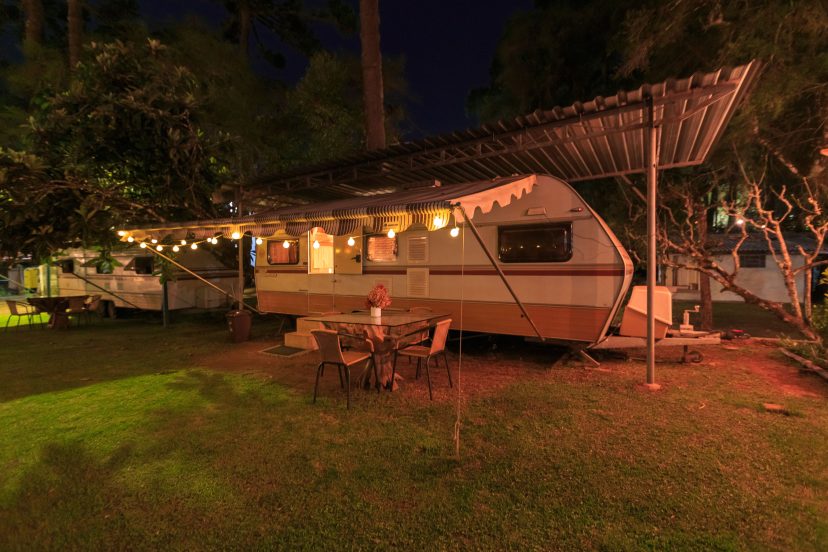
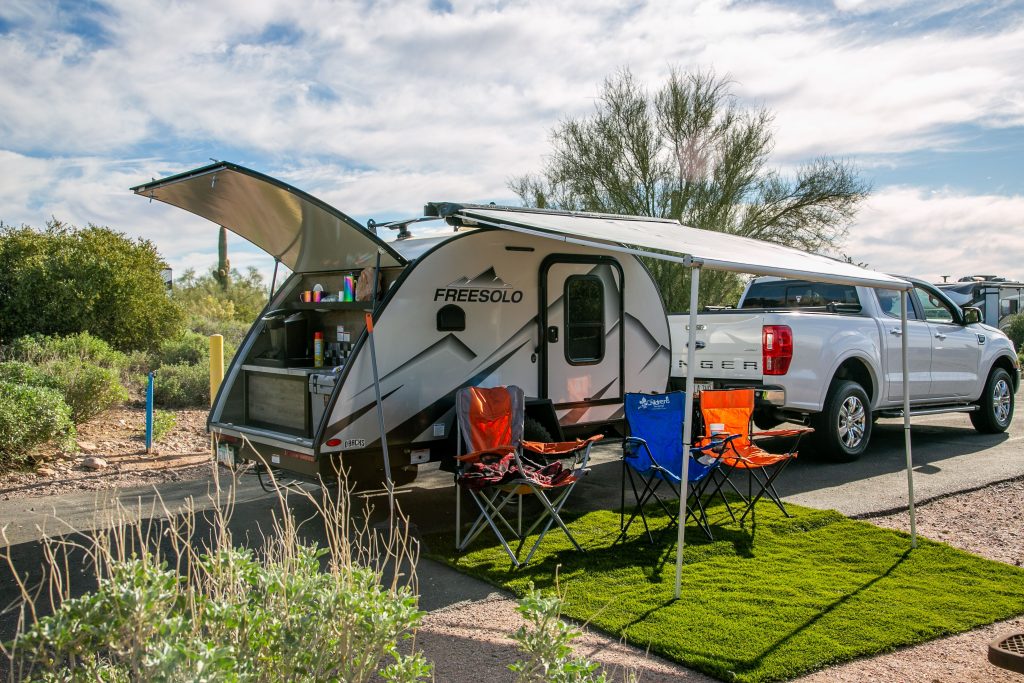
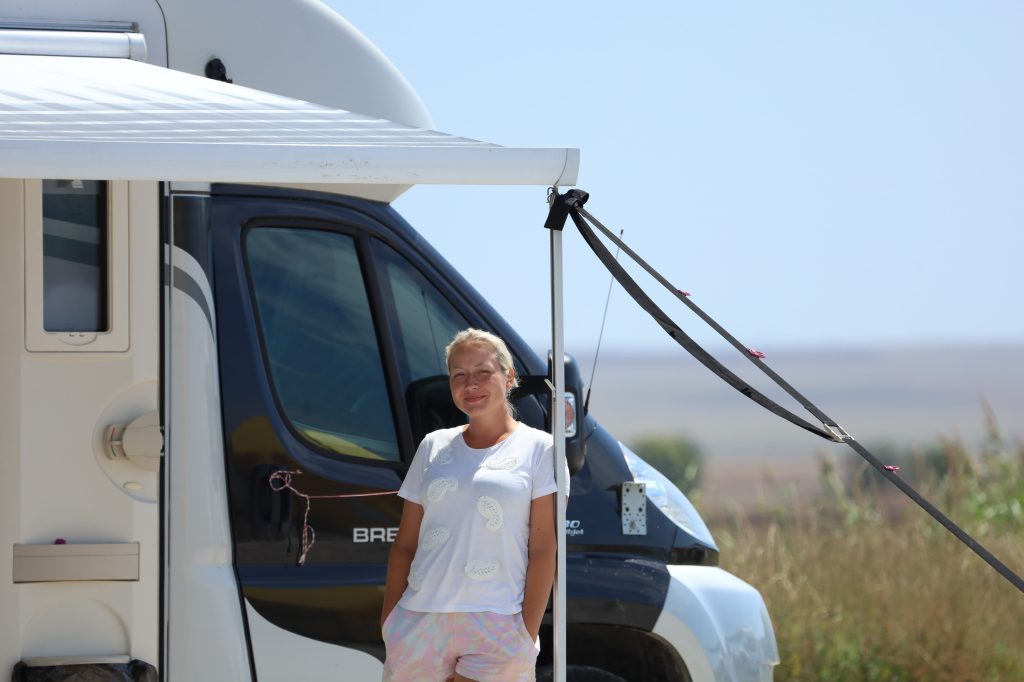
An awning creates usable shade beside your RV, giving you a covered area for chairs, shoes, a small table, or campsite meals when the sun gets intense.
The right awning for camper use can shield the doorway from light drizzle, but it is not a storm shelter. Easy retraction matters as much as coverage.
Measure Before You Buy an Awning for Camper
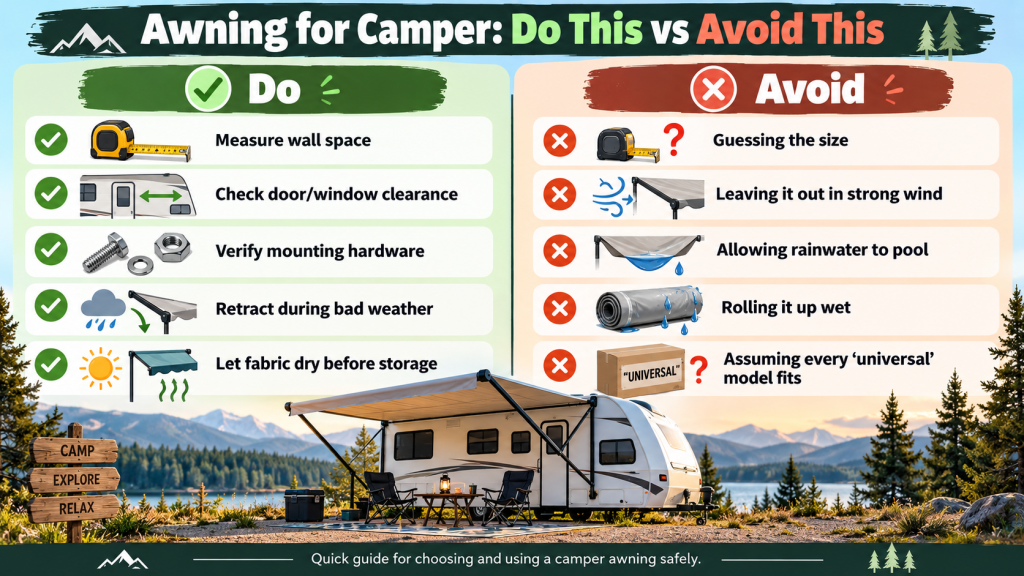
Start with clear wall space. Doors, windows, lights, slide-outs, storage doors, and roofline parts can interfere with arms or brackets.
For a replacement, record required mounting measurements, arm spacing, roller length, projection, and wall height. Confirm whether the package includes the complete awning or only fabric, arms, a roller, or hardware. Accurate measurements beat guessing from the old awning’s advertised size.
Manual vs. Electric Camper Awnings
Manual awnings suit campers who value simplicity. A crank avoids a motor and usually reduces electrical work, although deployment takes more effort.
Electric awnings retract quickly, which helps during short stops and changing weather. Motors, wiring, and switches add serviceable parts, though some models include manual backup. Choose an awning for camper use that you can retract confidently.
Fabric, Frame, and Projection: What Matters
Vinyl is common because it handles moisture well and cleans easily. Woven synthetics offer different texture and airflow. Follow the fabric maker’s care instructions.
Frame design matters too. Check arm construction, pitch adjustment, hardware, and replacement-part availability. Projection determines shade depth, but bigger is not automatically better. A larger canopy needs more clearance and presents more area to wind, so balance coverage with your RV’s space.
Recommended Awning for Camper Options
These five options cover compact electric setups, larger powered canopies, universal replacement systems, and a manual hardware solution. Before ordering any awning for camper use, confirm mounting dimensions and exactly what the package includes.
| Product | Operation | Best for | Main consideration |
| EROMMY 10FT | Electric + manual backup | Compact campers | Less lateral coverage |
| Suncode 17x8FT | Electric | Mid-to-large RVs | Verify power and wall space |
| Awnlux 18×8 Ft | Electric | Broad patio shade | Needs long clear wall space |
| RVeaves 15Feet | Electric | Replacement projects | Measure existing hardware |
| Solera 69 in. Hybrid Kit | Manual crank | Reusing roller/fabric | Hardware kit only |
EROMMY 10FT Electric RV Awning with Motor & Manual Crank, Retractable Camper Awning for RVs, Trailers, 5th Wheels & Motorhomes, Adjustable Arms, Black Fade Fabric
Best for: Compact campers that still want powered deployment
This 10-foot electric awning combines motorized extension with a manual crank backup, useful when power is unavailable. Adjustable arms let the owner alter pitch, while the shorter span can suit smaller RV walls better than oversized systems. Its main limitation is reduced lateral coverage compared with longer awnings.
Suncode RV Awning for RV&Camper-Motorized RV Awning,Electric Camper Awning Complete Kit-17x8Ft-White Frame &Sliver Fade
Best for: Buyers wanting a complete mid-to-large powered kit
The Suncode package uses a 17-by-8-foot format with motorized operation and a full-kit approach. Its listing specifies aluminum arms and vinyl fabric, making it a candidate when replacing more than fabric alone. Because it is a large powered system, verify clear wall space, mounting geometry, and electrical requirements before buying.
Awnlux White Motorized Modular Retractable RV Awning Full Set Assemblies for RV, 5th Wheel, Travel Trailers, Toy Haulers, and Motorhome – RV Trailer Awning for Home or Camper – 18×8 Ft – Blue Strip
Best for: Larger RVs that prioritize broad patio shade
This 18-by-8-foot motorized configuration suits rigs with enough unobstructed sidewall length for a larger canopy. The product family comes in multiple sizes and color combinations, which can help when matching an existing RV. Its generous span is also its main consideration, so careful measurement is essential before installation.
RVeaves Black Electric Power RV Awning Frame and Fabric Assemblies Full Set for RV,5th Wheel,Travel Trailers,Toy Haulers,and Motorhome RV Trailer Awning for Home or Camper (15Feet, Black Solid)
Best for: Buyers seeking an electric replacement with broad stated compatibility
This 15-foot full set uses electric operation and is marketed for compatibility with several common RV awning systems. Its arms allow pitch adjustment, and the product family covers multiple widths. That flexibility helps with replacement projects, but “universal” never replaces measurement; rails, brackets, clearances, and wiring still need to suit your RV.
Solera 69 in. Hybrid Universal RV Awning Arms Hardware Kit, Easy to Install, Two-Position Pitch, Auto Rain Dump, Crank Wand, Installation Hardware Included, Simple One-Step Setup, Black – 434727
Best for: Campers who want manual operation without internal wiring
This manual arm-and-hardware kit uses a crank wand and offers two-position pitch adjustment. It is designed for Solera systems and several major competing awning brands, making it useful when compatible fabric and roller components are already present. It is not a complete awning, so buyers must account for the parts they still need.
How to Match an Awning to Your Camper Type
Travel trailers, fifth wheels, motorhomes, and truck campers offer different wall space. Small trailers often benefit from shorter systems, while larger rigs may accept broader shade. Slide-outs and tall walls can complicate arm placement.
If the roller, rail, and brackets remain sound, replacing worn fabric may make sense. Bent arms, failing motors, or obsolete hardware can make a complete awning for camper replacement cleaner.
Weather, Wind, and Rain Safety
Treat an RV awning as deployable shade, not permanent roofing. Wind can load fabric quickly, while pooled rain adds weight. Pitch may help light rain drain, but it does not make an awning storm-ready.
Retract it when high winds or heavy rain threaten and before leaving camp. Because weather changes quickly, pair awning habits with a broader camping safety routine that includes checking forecasts, site hazards, and emergency basics.
Research-Backed Reasons Shade Matters
Shade does more than make a campsite feel nicer. A 2016 field study in the International Journal of Biometeorology involved 1,284 participants in Tempe, Arizona, and found that shade improved outdoor thermal comfort, with thermal sensation ratings about one point lower on a nine-point scale in shaded conditions. The setting was hot, dry, and urban rather than an RV campground, so the finding supports shade generally—not a particular awning design.
Sun protection still takes more than a canopy. CDC ultraviolet-radiation guidance updated in 2026 recommends combining shade with protective clothing and sunscreen because shade reduces exposure rather than eliminating it.
Operational guidance adds another practical layer. Lippert’s RV awning operation guide describes awnings as equipment intended for shade rather than as wind or rain blockers. That is manufacturer guidance rather than controlled research, but it reinforces a sound habit: retract the awning when conditions become unfavorable.
Installation: DIY or Professional?
Fabric-only replacement may suit experienced DIY owners, but complete installation is harder. Long rollers are awkward, powered parts can create hazards, and incorrect wall mounting can cause damage.
Electric systems also require proper wiring. Read the exact model manual before starting. If structural mounting or electrical work exceeds your experience, professional installation is a sensible part of the awning for camper budget.
Maintenance That Extends Awning Life
Let the canopy dry before rolling it up whenever possible. Damp storage encourages staining and biological growth. Remove dirt gently and use the fabric maker’s approved cleaning method.
Inspect seams, rails, pivots, fasteners, wiring, and the roller. If an awning for camper use retracts unevenly, makes unusual noises, or sags, stop and investigate. Small issues are easier to fix before they become travel-day failures.
Budgeting Beyond the Purchase Price
The purchase price is only part of the project. A complete awning may require labor, sealant, wiring, switches, or brackets. A component kit may still need compatible fabric and a roller.
Consider repairability too. Available motors, arms, fabric, and hardware simplify future ownership. Before ordering an awning for camper upgrade, compare total installed cost with fabric-only repair or a manual conversion.
Common Buying Mistakes to Avoid
Buying by nominal width alone is a common mistake. Another is assuming “universal” means every bracket, hole, and rail will match. Compatibility still depends on the RV.
Do not choose only by maximum projection. The canopy must clear windows, doors, slide-outs, and campsite obstacles. Never treat water-resistant fabric as permission to leave an awning deployed unattended in uncertain weather.
When a Replacement Fabric Is Enough
If the arms move smoothly, the roller is straight, and hardware is secure, worn fabric may be all that needs replacement. That keeps working hardware and can lower cost.
Measure by the manufacturer’s method because fabric dimensions do not always match nominal width. A full awning for camper replacement makes more sense when arms are bent, the motor fails, brackets are damaged, or several major components need work.
Awning for Camper FAQs
What size awning for camper use should I buy?
Measure the RV’s clear mounting area and follow the sizing method for the specific system. Do not choose solely from old fabric width or overall RV length. Check doors, windows, slide-outs, lights, and bracket locations, then confirm whether the advertised dimension refers to fabric, roller length, or arm spacing.
Is a manual or electric RV awning better?
Neither is universally better. Manual awnings suit owners who value simplicity and want to avoid motors or internal wiring. Electric awnings retract faster, which is convenient for frequent stops. If you choose electric, a documented manual override can be useful when power or a motor is unavailable.
Can I leave my camper awning out in the rain?
Light rain may be manageable with correct pitch and drainage, but an RV awning should not be treated as a storm shelter. Heavy rain can pool on fabric, and wind can load the structure. Follow the manufacturer’s operating limits and retract the awning early when conditions become unfavorable.
Is it possible to install an RV awning on my own?
Experienced owners may install replacement fabric or complete systems, but the job can involve long components, structural mounting, tensioned parts, and electrical wiring. Read the model-specific installation manual first. If the work requires skills or equipment you do not have, professional installation is the safer choice.
How long does camper awning fabric last?
There is no single reliable lifespan because UV exposure, climate, cleaning, storage moisture, wind events, and usage all affect fabric condition. Inspect it for cracking, separation, weak seams, mildew, or tears. Replacing deteriorated fabric based on condition is more useful than relying on a fixed number of years.
Final Recommendation: Choosing the Right Awning for Camper
The best awning for camper use is one that fits correctly, provides enough shade, and stays easy enough to operate that you will retract it when conditions change. Compact rigs may suit the EROMMY 10FT electric model, while owners reusing compatible roller and fabric components may prefer the manual Solera hardware kit.
Whichever style you choose, verify wall space, mounting dimensions, included components, power requirements, and replacement-part availability before ordering. Do not buy on width or appearance alone. For most campers, accurate fit, dependable operation, easy weather response, straightforward maintenance, and ready access to replacement parts matter more than extra features.