Camping Knots Every Camper Should Know
We may earn a commission for purchases made using our links. Please see our disclosure to learn more.
A loose guyline can turn a peaceful night into an exercise in chasing flapping fabric. A poorly chosen knot can also leave your clothesline sagging or make a tarp frustrating to adjust. Learning a handful of Camping Knots solves these ordinary problems without filling your pack with specialized hardware.
You don’t need to memorize dozens of complicated rope patterns. The useful ones perform specific jobs: making a fixed loop, attaching cord to a post, joining two lines, or creating adjustable tension. Once you know which job each knot does, choosing one becomes much easier.
This guide explains the knots worth practicing first, how to tie them, where they work best, and what gear makes campsite rigging simpler.
Which Camping Knots Are Worth Learning First?
Start with three: the bowline for a fixed loop, the taut-line hitch for adjustable tent guylines, and the trucker’s hitch for tightening a ridgeline. Together, they solve many common shelter problems.
A figure-eight stopper and a square knot are useful supporting skills, although neither should substitute for a properly secured shelter anchor.
Choose the Right Cord and Learn Basic Rope Terms
A working end is the loose tip you’re moving. The standing part is the longer section that carries tension. A bight is a curved section of cord that bends back without crossing over itself.
Thin, slick guylines save weight but may make friction hitches harder to hold.
Inspect your cord for damaged fibers, worn areas, and hardened sections. Never assume a rope labeled strong enough for camping can safely support a person. Climbing and rescue require appropriate rated equipment and trained technique.
Bowline: Make a Fixed Loop That Stays Its Size
The bowline creates a loop that doesn’t tighten around an attachment point as you pull.
- Make a small loop in the standing part, leaving a working end.
- Bring the working end up through that loop.
- Pass it behind the standing part and back down through the original loop.
- Pull the standing part and loop to dress the knot, then tighten it neatly.
Leave a generous tail and use an appropriate backup stopper where needed. Bowlines can loosen when repeatedly unloaded or shaken, so inspect them after the weather changes.
Taut-Line Hitch: Adjust Tent Guylines Without Retying
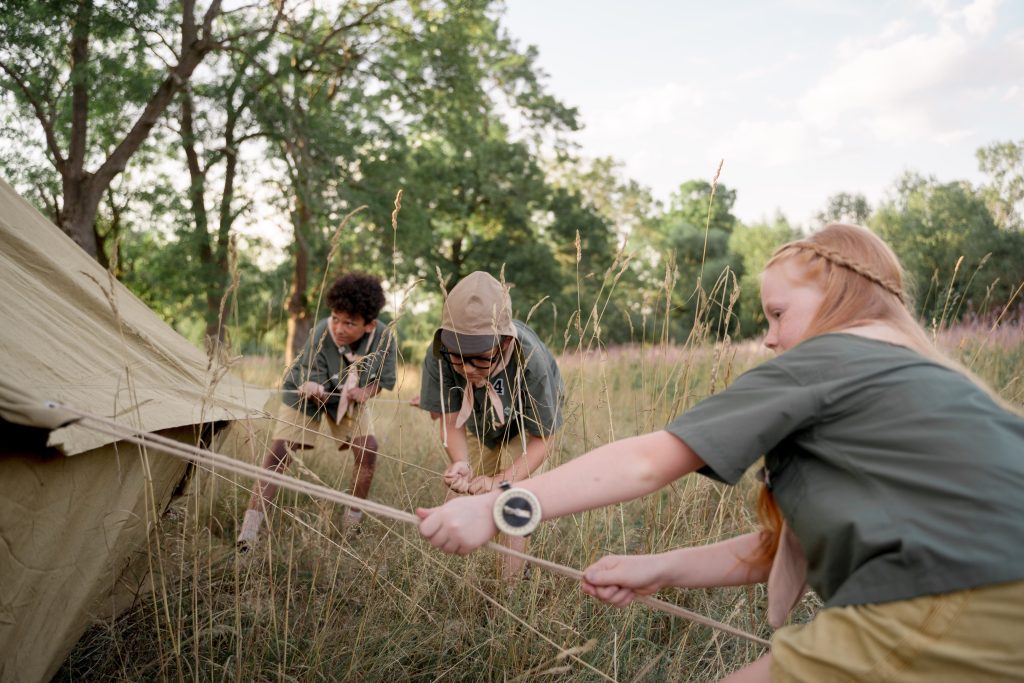
The taut-line hitch grips a line but can slide when you deliberately push it.
Pass the cord around a stake or sturdy anchor and return the working end alongside the standing part. Wrap the end twice around the standing part inside the loop toward the anchor. Add a final wrap outside the loop, then dress and snug the hitch.
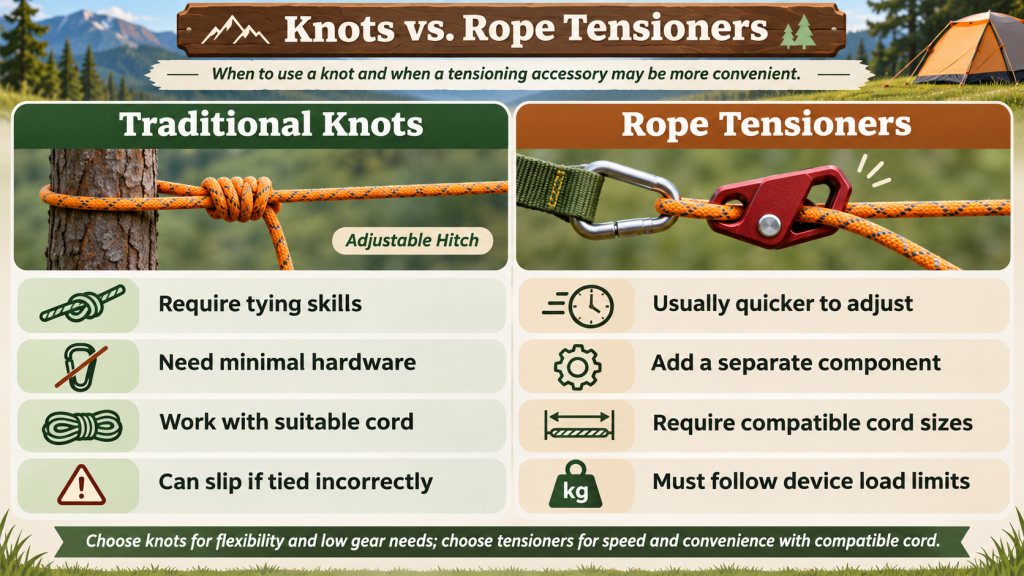
Slide the hitch to change tension and test whether it holds. Very smooth or thin cord may slip; use the tent’s compatible mechanical tensioner instead if necessary. Don’t overtighten delicate fabric panels.
Trucker’s Hitch: Pull a Ridgeline Firmly Into Place
The trucker’s hitch creates a simple hauling arrangement that helps you tension a tarp ridgeline.
First anchor one end of your rope securely. Form a suitable midline loop in the standing section, pass the free end around the far anchor, and feed it through the loop. Pull the free end to tension the line, then secure it with a reliable finishing hitch.
Keep fingers clear of pinch points and stop before the cord or anchor is overloaded. A trucker’s hitch increases pulling force, so more tightening isn’t automatically better. Use tree-friendly protection around suitable anchors.
Clove Hitch: Attach Rope Quickly to a Pole
A clove hitch is useful when starting a simple lashing or temporarily attaching a cord to a smooth, fixed pole.
Wrap the working end around the pole, cross it over the first wrap, go around again, and tuck the end beneath the most recent turn. Pull both ends to set the hitch.
Its convenience has a trade-off: shifting or alternating pulls can loosen it. Use a suitable backup for an important connection, and don’t rely on it as the sole knot holding a critical shelter in strong wind.
Two Half Hitches: Secure a Line Around an Anchor
Two half hitches make a straightforward attachment around a post, ring, or similar fixed object.
Run the working end around the anchor. Pass it around the standing part and through the opening to make the first half hitch. Repeat in the same direction to form a second hitch, then tighten both against the anchor.
This arrangement is less convenient than a taut-line hitch when you need frequent adjustments, but it’s easy to learn and practical for ordinary camp chores.
Sheet Bend: Join Two Lengths of Cord
If one guyline doesn’t reach a suitable stake, a sheet bend can join it to an extension.
Make a U-shaped bight in the thicker line. Pass the thinner line’s working end through the bight, around both legs, and beneath its own standing section. Dress the knot so the two loose ends emerge on the same side.
Check it under a gentle pull before relying on the connection. Slippery lines may require a double sheet bend or another manufacturer-approved solution. Avoid improvised joins in high-consequence applications.
Figure-Eight and Square Knots: Know Their Different Jobs
A simple figure-eight stopper creates a bulky knot near a rope’s end. Form a loop, carry the working end around the standing part, and feed it back through the loop.
The square knot joins two ends for light-duty binding, such as closing a bundle. Tie right over left, then left over right, and tighten evenly.
Never treat a square knot as a dependable bend for connecting loaded ropes. It can capsize or slip, especially with uneven tension or mismatched materials.
Use the Right Knot for Tents, Tarps, and Clotheslines
For a tent, attach a bowline at the reinforced guyout and use a taut-line hitch or compatible tensioner toward the stake. Follow the tent manufacturer’s guyline directions rather than tying onto arbitrary fabric loops.
For a tarp ridgeline, use a secure fixed anchor at one end and a trucker’s hitch for controlled tension at the other. Protect trees from concentrated cord pressure and observe campground restrictions.
For a clothesline, start with solid anchors and keep the span modest. Review a broader camping gear list for beginners if you’re assembling the rest of your shelter and camp setup.
Practice, Check, and Store Your Knots Properly
Learn each knot with two contrasting pieces of cord, then repeat it until you can recognize a correctly dressed shape. Dressing means arranging the turns neatly; setting means tightening the knot before putting it to work.
Before leaving a setup unattended, pull-test each connection, check tails, and look for abrasion where lines pass around rough objects.
Keep guylines out of walking routes where possible. Dry wet cord before storage and coil it loosely to avoid unnecessary tangles next time.
Recommended Gear for Learning and Using Camping Knots
GEAR AID Heavy Duty 550 Paracord, 100 ft
Best for: A general-purpose campsite cord supply.
This nylon utility cord has a 4 mm, seven-strand construction suited to shelter tie-downs, clotheslines, and repeated knot practice. A longer length offers flexibility when anchors are far apart. It’s bulkier than specialized thin guyline, and the manufacturer explicitly states it isn’t suitable for climbing or supporting people.
ThreeBulls 1.8mm Fluorescent Reflective Guyline Tent Rope, 65 Feet
Best for: Lightweight camping and tent setups.
This 1.8 mm reflective cord provides approximately 65 feet of line for securing tents, tarps, and awnings. Its bright green color and reflective material make it easier to spot when illuminated at night. The thin diameter saves packing space but can be harder to handle and may not grip every adjustable hitch securely.
Pro-Knot Outdoor Knots Waterproof Plastic Fan Pack
Best for: Beginners who want instructions at camp.
This pocket-sized reference uses waterproof plastic cards with step-by-step illustrations for common knots, including the bowline, sheet bend, and trucker’s hitch. It can travel in a pack without requiring a phone connection. It’s a reference rather than a hands-on training course, so practice the movements before relying on them outdoors.
Nite Ize Figure 9 Reflective Tent Line Kit – 2 Count (2 Pack)
Best for: Campers who prefer quick guyline adjustments.
Each kit includes four lightweight Figure 9 tensioners and four reflective green cords measuring eight feet each. The tensioners help secure tent lines without complicated knots, making adjustments convenient during setup. However, the supplied cord lengths may be insufficient for larger shelters, and the plastic tensioners are not designed for climbing applications.
GEERTOP Reflective Guylines 4mm with Aluminum Adjuster Tensioners
Best for: Replacing existing tent and tarp guylines.
These reflective guylines measure approximately 13 feet each and feature aluminum tensioners for adjusting line tension. The six-piece set offers a convenient option for replacing worn tent cords or preparing additional tie-out points. Their 4 mm diameter is easier to handle than very thin cord, although the thicker construction adds packing bulk.
What Outdoor Safety Guidance Reveals About Knot Reliability
Outdoor guidance emphasizes matching the knot to the actual load. Detailed tent setup recommendations explain using bowlines at designated guyout points and a trucker’s hitch where a tensioner isn’t available. The advice also stresses attaching lines in the correct direction and distributing tension around the shelter.
A separate technical knot-tying guide warns that a bowline can loosen when unloaded and recommends a stopper backup. That limitation matters on flapping tarps, which repeatedly tighten and relax.
Equipment instructions add another layer: the CamJam XT safety guidance requires inspection and adherence to working load limits. These are expert and manufacturer recommendations, not controlled studies proving one camping knot is universally strongest. For everyday camping, correct selection, careful tying, and regular inspection matter more than claiming a single unbeatable knot.
Frequently Asked Questions About Camping Knots
What is the easiest camping knot for beginners?
Two half hitches are a comfortable starting point because their repeated structure is easy to remember. For shelter use, learn the bowline next. Practice with thicker cord at home, check how the finished knot should look, and move to thinner guylines only after you can tie the shape reliably.
Which knot is best for tightening tent lines?
A taut-line hitch is convenient for adjustable tent guylines made from cord that grips well. A trucker’s hitch helps when you need more pulling leverage. If your tent includes purpose-designed tensioners, those may be quicker and more predictable on slippery cord. Always check the tension after wind or rain.
Can paracord be used for tent guylines?
Yes, suitable utility paracord can secure ordinary tent guylines, but it may be heavier or stretchier than dedicated shelter cord. Choose an appropriate diameter and follow the tent manufacturer’s guidance. Do not confuse a paracord’s advertised breaking strength with permission to use it for climbing, rescue, or supporting people.
Do camping knots weaken rope?
Bending cord sharply and squeezing fibers into a knot can reduce how much load a rope withstands compared with its unknotted condition. The reduction varies by rope, knot, and loading conditions. Avoid designing your setup around a printed breaking-strength number alone, especially when a failure could injure someone.
How do I stop a knot from slipping in wet weather?
Use a knot appropriate for the cord’s material and diameter, dress it carefully, and leave an adequate tail. Check how the rope behaves when wet instead of assuming it will grip identically. For slick guylines, compatible line tensioners can be easier to manage; inspect everything after conditions change.
Conclusion: Start With Three Reliable Camping Knots
You don’t need an impressive knot collection to make camp run smoothly. Learn a bowline for fixed loops, a taut-line hitch for small adjustments, and a trucker’s hitch for a tensioned ridgeline. Then add clove hitches, two half hitches, and a sheet bend as your setups become more varied.
The right cord matters as much as the technique. General-purpose paracord handles routine chores, while reflective guyline makes tent tie-outs easier to spot. A compact Pro-Knot reference can help you check the pattern, but it shouldn’t replace practice.
For your next trip, cut a short practice length, learn those first three Camping Knots, and test them on a low-stakes tarp setup before relying on them overnight.