5 Portable Power Stations for Camping
We may earn a commission for purchases made using our links. Please see our disclosure to learn more.
Nothing humbles a camping trip faster than a dead phone, a drained lantern, or a mini fridge giving up right when the snacks matter most. You pack the tent, the cooler, the coffee gear, the bug spray, and then—oops—your power plan is basically “hope and vibes.”
That is where Portable Power Stations for Camping come in. Think of them as oversized power banks with enough muscle to charge phones, run lights, power small appliances, and keep essential gear alive when you are away from outlets.
In this guide, you’ll learn how to choose the right size, what features actually matter, which mistakes to avoid, and five Amazon-friendly product options worth considering.
Affiliate disclosure: This article may contain affiliate links, meaning we may earn a small commission at no extra cost to you.
What Are Portable Power Stations for Camping?
Portable Power Stations for Camping are rechargeable battery units with outlets, USB ports, and charging inputs. Instead of burning gas like a traditional generator, they store electricity and release it when you plug in your gear.
You can use one for:
- Phones and tablets
- LED camp lights
- Cameras and drones
- Laptops
- CPAP machines
- Portable fridges
- Fans
- Small cooking gadgets
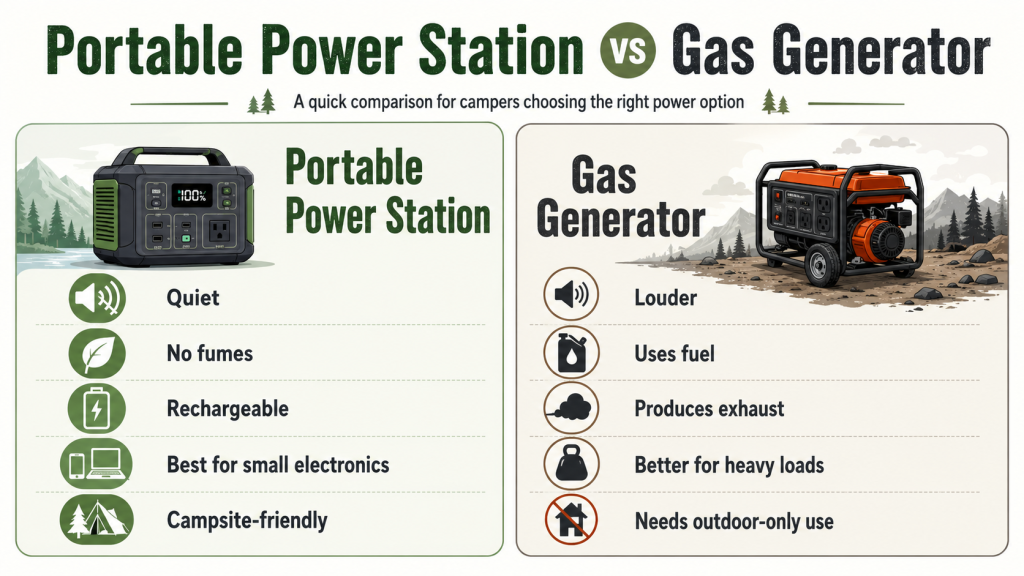
They are quiet, clean, and easy to use. No fuel smell. No loud engine. No awkward campground side-eye because your generator sounds like a lawn mower with unresolved anger.
Why Campers Are Switching From Gas Generators
Gas generators still have a place, especially for heavy-duty power needs. However, many campers now prefer a battery generator because it is quieter and easier to manage.
A portable battery pack also works better in shared campgrounds, family campsites, and quiet nature areas. You can run a light inside your tent, charge a phone near your sleeping bag, or keep a camera battery ready without waking the whole forest.
For weekend trips, car camping, RV camping power needs, and emergency backup, a rechargeable power station often feels simpler.
How to Choose the Right Capacity
Capacity is usually measured in watt-hours, or Wh. This indicates the amount of energy the station is able to store.
Here is the friendly version:
- 200–300Wh: Phones, tablets, lights, small fans
- 500–800Wh: Laptops, cameras, CPAP use, longer trips
- 1,000Wh+: Portable fridges, multiple devices, RV camping, family setups
Ask yourself: what do you really need to power? A solo camper charging a phone and lantern does not need the same setup as a family running a fridge, fan, and three tablets for sleepy kids in the backseat.
Quick Watt-Hour Cheat Sheet
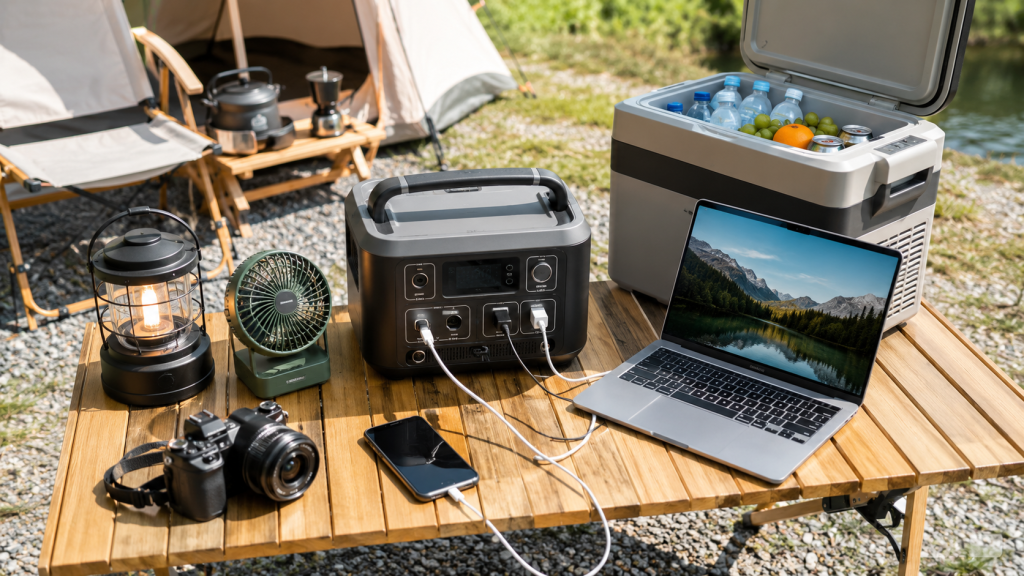
Use this as a rough guide before buying Portable Power Stations for Camping:
- Smartphone: 10–15Wh per charge
- Tablet: 25–40Wh per charge
- Laptop: 50–100Wh per charge
- LED lantern: 5–20Wh per night
- Portable fan: 20–60Wh per night
- CPAP machine: often 200–500Wh per night, depending on settings
- 12V fridge: often 300–700Wh per day, depending on temperature and use
Always leave a buffer. Camp life is not a spreadsheet. Someone always forgets to charge something.
Battery Types: LiFePO4 vs. Standard Lithium-Ion
Many newer solar generator for camping models use LiFePO4 batteries. These are popular because they tend to offer long cycle life and better stability.
Standard lithium-ion batteries can still be lighter and compact, but LiFePO4 is often preferred for frequent camping, overlanding, and long-term backup use.
For casual weekend trips, either can work. For regular outdoor use, LiFePO4 is usually worth a closer look.
Charging Options That Matter
A good camping power station should offer more than one way to recharge.
Look for:
- Wall charging before your trip
- Car charging while driving
- Solar panel compatibility
- USB-C charging on smaller models
- Fast AC charging for quick top-ups
Solar charging sounds dreamy, and it can be. But it depends on sunlight, panel size, weather, and campsite shade. If your site is tucked under pine trees, your solar panel may spend the day taking a very scenic nap.
Ports and Outlets to Check Before Buying
Before choosing Portable Power Stations for Camping, check the actual ports.
Helpful options include:
- AC outlets for regular plugs
- USB-A for older cables
- USB-C for phones, laptops, and tablets
- 12V car socket for fridge or camping accessories
- Wireless charging pad, if available
- Display screen for battery percentage
Also check the output limit. A power station may have the outlet you need, but not enough wattage to run your device.
Safety Tips for Campsites
Portable power stations are safer and cleaner than fuel-burning generators, but you still need common sense.
Keep your unit dry, shaded, and off bare dirt. Do not block vents. Avoid charging it inside a hot closed car. Also, do not overload it with devices that pull more power than it can handle.
For tent use, keep cords tidy. Nobody wants a midnight trip hazard while hunting for the flashlight.
Smart Ways to Save Battery
Small habits can make your off-grid power last longer.
Try these:
- Use LED lights instead of high-watt lamps
- Charge phones during the day, not all night
- Turn off unused AC outlets
- Pre-chill your fridge before leaving home
- Use airplane mode when signal is weak
- Keep the unit out of extreme heat or cold
A portable power station is like a cooler. It works best when you do not ask it to perform miracles after poor planning.
Best Setup by Camping Style
For solo camping, a 200–300Wh unit may be enough. Add a small solar panel if you plan to stay out for more than two nights.
For family camping, consider 700–1,000Wh. Kids have a magical ability to drain every device within a ten-foot radius.
For RV camping, look at 1,000Wh or more, especially if you run a fridge, fan, or several devices.
For CPAP camping, check your machine’s wattage, humidifier use, and DC adapter options. A CPAP battery for camping should be planned carefully, not guessed.
Common Mistakes to Avoid
Do not buy based on size alone. A big-looking station may have less useful power than you expect.
Avoid these mistakes:
- Ignoring watt-hour capacity
- Forgetting surge wattage
- Assuming all solar panels work with all stations
- Running high-heat appliances too long
- Leaving no backup for medical devices
- Buying too small to save money, then replacing it later
The cheapest power station is not always the best value. The right one is the one that matches your actual trip.
When a Power Station Is Not Enough
Portable Power Stations for Camping are great for electronics, lights, and small appliances. However, they are not ideal for electric space heaters, large air conditioners, or high-watt cooking gear.
Heat uses a lot of energy. If cold weather is your biggest concern, plan your warmth separately with insulation, safe heating habits, and proper gear. This guide to safe camping heaters for tent camping can help you choose smarter cold-weather options.
A power station supports comfort. It should not be your only survival plan.
5 Best Portable Power Stations for Camping
Below are five real product options commonly found on Amazon. Always check current pricing, availability, and the latest model details before buying.
1. Anker Portable Power Station SOLIX C300
The Anker Portable Power Station SOLIX C300 is a compact option for light camping, short trips, and device charging. It offers 288Wh capacity, 300W output, 600W surge, and multiple ports, including AC outlets, USB-C, USB-A, and a car socket.
Features:
- 288Wh LiFePO4 battery
- 300W output, 600W surge
- Multiple USB-C ports
- Compact travel-friendly design
Best for: Solo campers, weekend trips, phones, laptops, lights, cameras, and small electronics.
2. EF ECOFLOW Portable Power Station RIVER 2 Pro
The EF ECOFLOW Portable Power Station RIVER 2 Pro is a reliable choice in the mid-range category. It offers 768Wh capacity, 800W wattage, solar-powered charging support, and a portable design for camping, residential, and commercial use.
Features:
- 768Wh battery capacity
- 800W output
- Solar charging compatibility
- Good for multiple devices
Best for: Campers who want more than phone charging but do not want a huge power station.
3. Jackery Explorer 1000 v2 Portable Power Station
The Jackery Explorer 1000 v2 Portable Power Station is designed for campers who need dependable power away from the grid. It has 1,070Wh capacity, 1,500W AC output, 3,000W surge peak, and a lightweight build of about 23.8 pounds.
Features:
- 1,070Wh capacity
- 1,500W AC output
- 3,000W surge peak
- Foldable handle
Best for: Road trips, RV camping, portable fridges, small appliances, and longer weekend adventures.
4. BLUETTI Portable Power Station AC180
The BLUETTI Portable Power Station AC180 is a high-capacity option with 1,152Wh LiFePO4 battery capacity, 1,800W output, and up to 500W solar input. It can also recharge quickly with AC input.
Features:
- 1,152Wh LiFePO4 battery
- 1,800W output
- 2,700W boost mode
- Fast solar charging support
Best for: Campers with heavier power needs, families, off-grid weekends, and backup use.
5. Goal Zero Yeti 300 Portable Power Station
The Goal Zero Yeti 300 Portable Power Station is a smaller rugged pick with 297Wh capacity, LiFePO4 battery chemistry, and water-resistant and dustproof outdoor-friendly design.
Features:
- 297Wh capacity
- LiFePO4 battery
- Water-resistant and dustproof design
- Compact size
Best for: Tailgating, light camping, short trips, and campers who want a tougher small unit.
Research-Backed Insights on Portable Power Stations for Camping
Battery power avoids gas-generator safety risks
One major advantage of Portable Power Stations for Camping is that they do not burn fuel or produce carbon monoxide. That makes them a quieter, cleaner option for charging phones, lights, cameras, and small camping gear. The CPSC has warned that portable gas generators are linked to serious carbon monoxide deaths, which is why battery power can be a safer fit for many campsites. Read more here: the quiet safety reason campers are switching to battery power.
Battery lifespan depends on how you store and use it
Many newer camping power stations use LiFePO4 batteries because they are known for long cycle life and stable performance. However, research shows that heat, storage conditions, and charge level can affect battery aging over time. In plain terms: keep your power station cool, dry, and properly stored between trips. Read the study here: the battery-aging lesson hiding inside your camping gear.
FAQs
What capacity portable power station is best for camping?
For light camping, 200–300Wh is usually enough for phones, lights, and small devices. For fridges, laptops, CPAP machines, or family trips, consider 700–1,000Wh or more.
Can a camping refrigerator be powered by a portable power station?
Yes, many can run a 12V camping fridge. Choose a model with enough watt-hours and a compatible 12V output. For weekend trips, 700Wh or higher is often more practical.
Are portable power stations safe to use inside a tent?
They can be used near or inside a tent if kept dry, ventilated, and protected from heat. Do not cover the vents, expose the unit to rain, or overload the outlets.
Can a portable power station be charged using solar panels?
Yes, many models support solar charging. Check the station’s solar input limit, connector type, and compatible panel wattage before buying.
Is a portable power station a smarter option than a gas generator for camping?
For quiet camping, small electronics, and clean power, yes. For heavy power needs, gas generators may still offer more runtime, but they require fuel and strict outdoor safety precautions.
Conclusion
The best Portable Power Stations for Camping make outdoor life easier without stealing the peace you came for. Start by listing your must-power items, then match them to the right capacity, ports, battery type, and charging options. A small unit may be perfect for a quiet solo weekend, while a 1,000Wh model can support family trips, RV camping, and longer off-grid stays. Choose wisely, pack with intention, and you can enjoy the glow of camp lights, warm coffee, charged cameras, and one less thing to worry about under the stars.