Best Coolers for Camping for Families and Solo Trips

We may earn a commission for purchases made using our links. Please see our disclosure to learn more.
Nothing ruins a camping trip faster than reaching for cold drinks and finding a sad, lukewarm puddle with floating cheese sticks. You planned the escape. You packed the snacks. You even remembered the bug spray. But the wrong cooler can still turn the whole food setup into chaos.
That is exactly why choosing the best coolers for camping matters more than most people think. The right one keeps food safer, drinks colder, and your campsite way less annoying to manage. In this guide, you’ll learn how to choose the right size, whether a hard-sided or soft-sided cooler fits your style, which features actually matter, and five strong Amazon US options worth a look.
Affiliate note: This article may include affiliate product recommendations, which means a commission may be earned at no extra cost to you.
Why your camping cooler matters more than you think
A cooler is not just a cold box with a handle. It is basically your campsite fridge, snack station, and peacekeeper all rolled into one.
It also plays a real food-safety role. The CDC says bacteria grow quickly in the “danger zone” between 40°F and 140°F, and perishable food should not sit out for more than two hours, or one hour above 90°F.
So yes, a good cooler helps with comfort. More importantly, it helps protect the potato salad from turning into a regret story.
How much cooler space you really need
A lot of people buy coolers the way they buy tote bags: bigger feels safer. Then they try lifting the thing and immediately rethink their life choices.
Popular Mechanics’ 2025 buying guidance gives a useful rule of thumb: 10–20 liters works for one or two people on a short outing, 20–40 liters suits a full-day event or small group, 40–60 liters fits a weekend camping trip for a small group, and 60+ liters makes more sense for longer trips or mid-sized groups.
If you camp solo, go smaller than your ego wants. If you camp with kids, go bigger than your optimism wants.
Hard-sided vs soft-sided coolers
This choice comes down to your camping style.
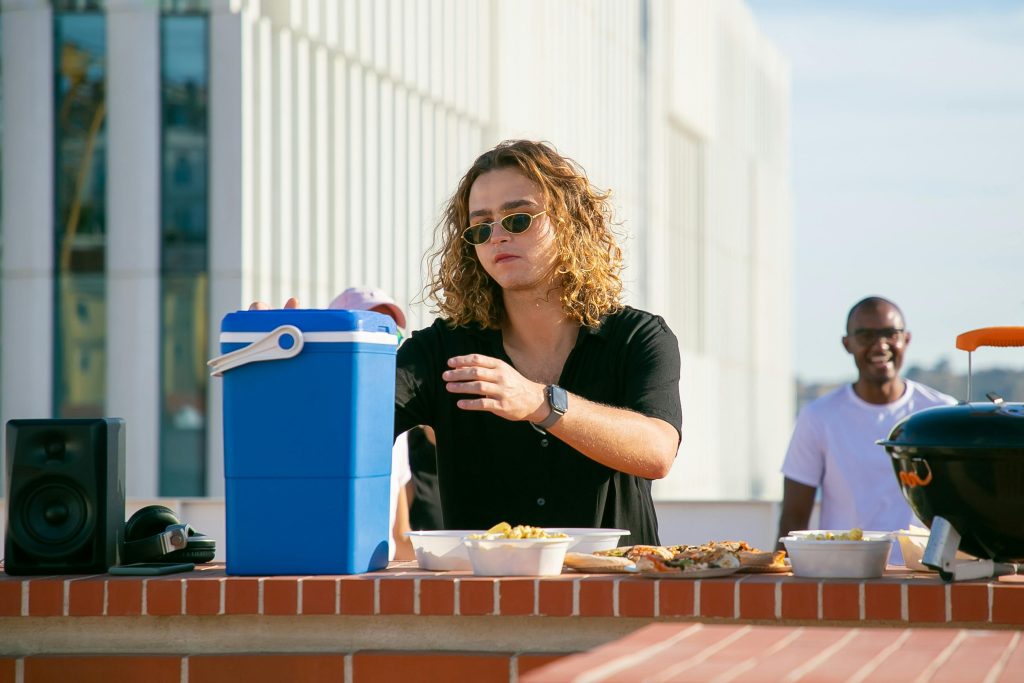
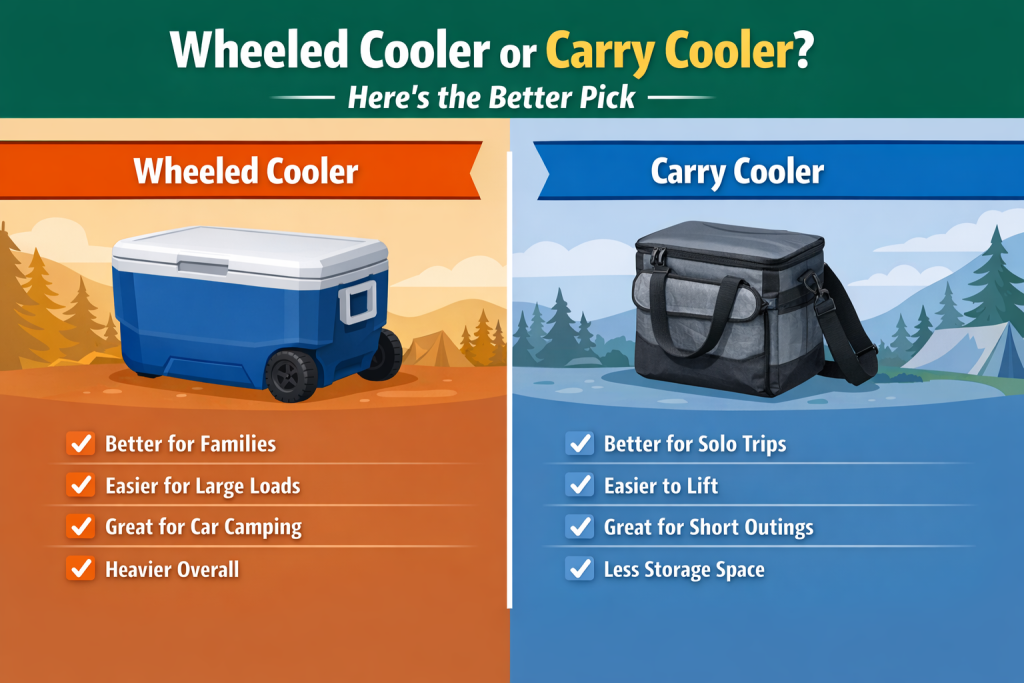
A hard-sided cooler usually gives you better structure, better durability, and stronger long-term ice retention. A soft-sided cooler is lighter, easier to carry, and great for short trips, day use, or extra drink storage. REI’s 2025 cooler picks include both hard and soft models, which says a lot: there is no one-size-fits-all winner.
Think of it like this: hard coolers are pickup trucks, soft coolers are hatchbacks. Both can be excellent. You just need the one that fits your weekend.
What actually keeps ice longer
Marketing loves phrases like “extreme cooling” and “arctic performance.” Real life cares about insulation, seal quality, sunlight, and how often you keep opening the lid because someone wants “just one more drink.”
Popular Mechanics notes that features like thick lid gaskets, good insulation, and thoughtful drainage improve real-world performance. It also points out that while roto-molding boosts durability, it does not automatically mean dramatically better insulation than every non-roto option.
That is helpful, because it means you do not always have to buy the heaviest, priciest cooler on the planet.
Features worth paying for
Some cooler features are genuinely useful. Others are basically camping jewelry.
The ones worth caring about are:
- thick insulation
- a solid lid seal
- drain plugs that are easy to use
- wheels for larger coolers
- sturdy handles
- dry baskets or divided storage
- leak-resistant lining for soft coolers
Popular Mechanics and REI both emphasize ease-of-use features like wheels, handles, drain systems, and storage organization because those little details affect daily campsite sanity more than flashy branding does.
Best cooler size for solo camping trips
If you camp alone or with one other person for an overnight, smaller coolers are often the sweet spot.
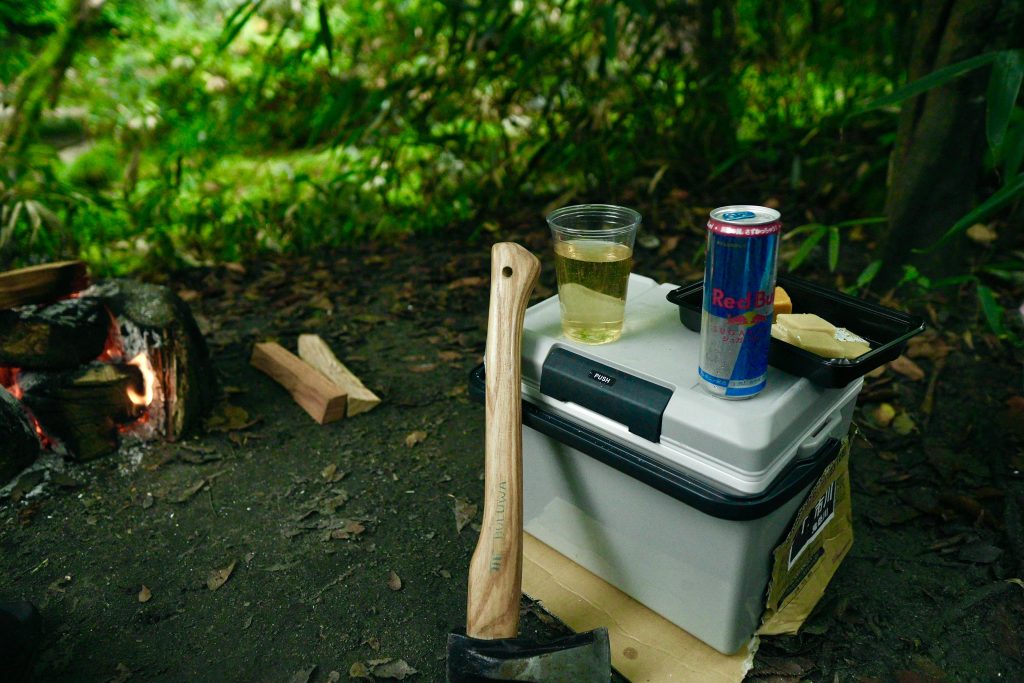
A compact portable cooler is easier to carry, easier to fit in a trunk, and less likely to waste ice cooling empty space. It also encourages smarter packing. You bring what you need instead of hauling half a grocery aisle into the woods. Based on Popular Mechanics’ sizing guidance, something in the 10–20 liter range works well for short solo trips.
Small coolers are underrated. They are like a good camp mug: less dramatic, more useful.
Best cooler size for couples or weekend trips
For two people doing a proper weekend, you’ll usually want a camping ice chest in the 20–40 liter range, or a bit larger if you’re packing full meals instead of mostly drinks and snack stuff. Popular Mechanics places this range right in the zone for day events and small-group use, with 40–60 liters becoming a better fit for weekend camping.
If you cook at camp, size up. If you mostly bring sandwiches, fruit, and beverages, you can stay lighter.
Best cooler size for family camping
Family camping is where cooler math gets humbling fast.
A family trip usually means juice boxes, sandwich fixings, breakfast food, maybe marinated meat, maybe extra ice packs, and somehow three different kinds of yogurt that all mattered deeply at home. For that reason, 40–60 liters or more is typically the practical range for weekend family camping, and 60+ liters is safer for longer outings.
If you have a bigger crew, sometimes two coolers work better than one giant one: one for drinks, one for food.
Best cooler for car camping setups
Car camping gives you more flexibility, which is great news for your cooler choices.
Because you are not carrying everything on your back, you can choose a larger insulated cooler with better structure, wheels, or divided storage. This is where hard coolers shine, especially if you like cooking at camp. And if you want your whole setup to feel less chaotic, pair your cooler plan with these smart car camping packing hacks so food, cookware, and dry goods do not end up in a messy trunk pile.
Best wheeled coolers for easy hauling
A full cooler gets heavy fast. Empty, many hard coolers already weigh around 20 pounds, and Popular Mechanics notes that once you add ice and drinks, carrying them often becomes a two-person job. That is why wheels are not a luxury on larger models. They are a peace treaty for your back.
If you camp with kids, park far from your site, or just prefer not to reenact a strongman contest before lunch, a wheeled cooler is absolutely worth considering.
5 best coolers for camping
Here are five strong options that cover different camping styles and budgets.
1) YETI Tundra 45 Cooler
This is the premium pick for campers who want rugged performance and do not mind paying for it. Amazon lists it with room for up to 26 cans using a 2:1 ice-to-contents ratio, plus up to 3 inches of insulation, rotomolded construction, and bear-resistant certification. It is a serious hard-sided cooler for people who camp often and want durability first.
Best for: frequent campers, overlanders, couples, and small families who want long-lasting gear.
2) Coleman Classic Series Insulated Portable Rolling Cooler with Wheels, 100-Quart
This is the family-hauler option. Amazon lists it as a 100-quart rolling cooler that keeps ice for up to 5 days. That large capacity makes it especially appealing for family camping, group trips, and car camping weekends where you need one big central cooler.
Best for: families, group sites, tailgate-style campers, and anyone who packs like the trip might last longer than planned.
3) RTIC 52 Quart Ultra-Light Wheeled Hard Cooler
RTIC’s Amazon listing highlights that this model is 30% lighter than rotomolded coolers of similar size while still using up to 3 inches of closed-cell foam insulation. That makes it a nice middle ground between performance and portability.
Best for: campers who want strong ice retention without dragging around a brick on wheels.
4) Titan Deep Freeze 60 (50+10) Can Wheeled Cooler
If you prefer soft-sided flexibility, this one brings a lot to the table. Amazon says it keeps ice up to 3 days, holds up to 60 cans, includes an easy-access lid, an insulated front pocket, and a leak-proof easy-clean lining.
Best for: weekend campers, drink-heavy setups, sports-and-camping crossover families, and people who want lighter rolling storage.
5) Coleman Pro 24-Can Premium Soft Cooler Lunchbox
Do not let the “lunchbox” label fool you. Amazon lists this soft cooler with 24-can capacity, cold retention up to 35 hours, a dry storage section, a puncture-resistant exterior, and a shoulder strap for hands-free carrying.
Best for: solo campers, short overnights, day trips, and anyone who wants a grab-and-go soft-sided cooler.
How to pack a cooler so food stays colder
A great cooler still needs a smart packing plan.
FoodSafety.gov recommends packing perishable foods straight from the refrigerator or freezer, using a thermometer to keep the cooler at 40°F or below, and separating raw meat from ready-to-eat foods.
A few practical tips:
- pre-chill the cooler before loading it
- use block ice for longer retention
- open the lid less often
- keep drinks in a separate cooler if possible
- store the cooler in shade, not direct sun
A cooler works a lot like air conditioning in a house. Open the door every two minutes, and you’re making it fight for its life.
What the expert testing says about the best coolers for camping
Two expert sources are especially useful here.
In a lab-tested cooler review for camping, OutdoorGearLab said it bought and tested 24 top-rated coolers to compare real-world performance. That kind of side-by-side testing is valuable because it looks beyond brand hype.
Meanwhile, REI’s expert cooler picks for 2025 offer a practical shortlist spanning both hard and soft coolers, which reinforces a useful point: the best camping cooler depends on how you camp, not just how impressive a product photo looks online.
Common cooler mistakes to avoid
The biggest mistake is buying for fantasy-you instead of real-you.
If you take short solo trips, you probably do not need a giant roto-molded beast. If you camp with kids, a tiny stylish cooler may feel cute for about 45 minutes. Another mistake is assuming ice-retention claims will hold up if your cooler sits in sun all day and gets opened nonstop.
Also, do not ignore food safety. The CDC’s 40°F rule is not a suggestion. It is the line between “great trip” and “why does everyone feel weird after lunch?”
FAQs about the best coolers for camping
What size cooler is best for a 2-day camping trip?
For one or two people, a cooler in roughly the 20–40 liter range usually works well for a 2-day trip. If you’re packing full meals, raw ingredients, and lots of drinks, go slightly larger.
Are hard-sided coolers better than soft-sided coolers for camping?
Usually for longer trips, yes. Hard-sided coolers tend to be more durable and better for longer cold retention, while soft-sided coolers are lighter and more convenient for short trips or day use.
How long should a camping cooler keep ice?
That depends on the cooler, the weather, and how often you open it. Some Amazon listings claim anywhere from 35 hours for smaller soft coolers to up to 5 days for large hard coolers.
Do I need a wheeled cooler for camping?
Not always. But if your cooler is large, packed for a family, or frequently moved from vehicle to campsite, wheels make a huge difference in comfort and convenience.
What should I look for when buying the best coolers for camping?
Focus on size, insulation, seal quality, portability, and how you actually camp. A solo hiker, a car camper, and a family of five do not need the same kind of cooler. Expert testing also suggests paying attention to wheels, gaskets, and easy-drain designs.
Conclusion
The best coolers for camping are not always the biggest, the priciest, or the ones that look toughest in a product photo. They are the ones that fit your trip, your group size, and the way you actually pack.
If you camp solo, a compact soft cooler may be perfect. If you camp with family, a wheeled hard cooler can save your weekend. And if you want the smartest choice overall, look for the sweet spot between insulation, portability, and everyday usefulness.
Pick the cooler that matches your real camping life, not your imaginary expedition documentary, and your next trip will feel a whole lot easier.