Best Tent Heaters for Camping for Cold Nights
We may earn a commission for purchases made using our links. Please see our disclosure to learn more.
The first time you wake up camping and realize your nose is cold inside your sleeping bag, it’s… humbling. You start doing that tiny internal math like: “If I don’t move, I stay warmer… but I also really need to pee.” 😅
That’s exactly why tent heaters for camping have become such a big deal—especially for shoulder seasons, high elevations, or anyone whose “cold tolerance” ends at mildly chilly. And no, this isn’t about turning your tent into a sauna. It’s about taking the edge off so you can actually enjoy the trip.
In this guide, you’ll learn how to choose the right heater style, what safety rules you shouldn’t bend (ever), how to match heat output to your tent, and which heaters people actually buy for real-world camping scenarios.
Affiliate note: This article includes a product section; as an Amazon Associate, you may earn from qualifying purchases at no extra cost to you.
What makes a “good” tent heater for camping?
A good camping heater isn’t just “hot.” It’s predictable, stable, and easy to control—because you’re using it around fabric, sleeping gear, and tired humans.
Here’s what you actually want:
- Steady heat output (not a blast furnace on one setting)
- Safety shutoffs (tip-over, overheat, low-oxygen/ODS on propane models)
- Portable size + sane weight
- A clear use case (tent vestibule? screen tent? camper? quick warm-up?)
- Low fuss setup in the dark, with gloves on
Think of it like this: a camping heater should behave like a calm friend who brings extra blankets—not like the chaotic buddy who shows up with fireworks.
Propane vs electric vs catalytic tent heaters
Propane (portable radiant heaters)
This is what most people mean when they say “tent heaters for camping.” They’re powerful, portable, and don’t need electricity.
Best for: quick warm-ups, car camping, hunting blinds, emergency heat
Trade-off: ventilation/CO risk management matters a lot
Electric (ceramic or fan heaters)
These can be wonderfully safe if you have a solid power setup (shore power at a campground, or a beefy power station).
Best for: campgrounds with outlets, campers/RVs, glamping tents
Trade-off: power draw is real (often 750–1500W)
Catalytic heaters
They can be efficient and quiet. Many people like them for steady warmth.
Best for: longer, lower-output heating
Trade-off: still fuel-burning = still needs careful ventilation
If you’re unsure? Most beginners do best with either:
- Propane radiant heater for brief warm-ups, or
- Electric heater when you have reliable power.
Safety rules you do not “wing”
I’m going to be your slightly annoying friend for a second—because safety with portable heat is not the place to freestyle.
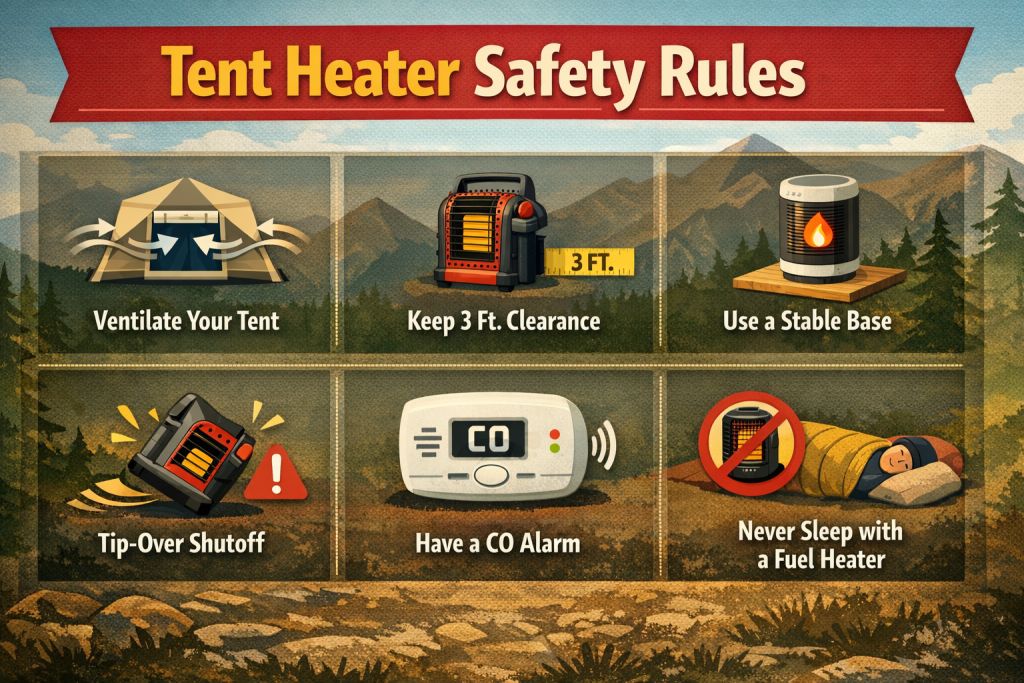
- Never sleep with a fuel-burning heater running.
- Keep a 3-foot safety zone around any heater (sleeping bags, jackets, curtains, gear—back it all up).
- Stable surface only. No “it’s fine on the duffel bag” moments.
- Skip extension cords for high-watt electric heaters unless the cord is heavy-duty and rated appropriately.
- Choose models with automatic shutoffs (tip-over/overheat; propane models often include ODS).
Why the intensity? Because the risk is real. The U.S. Consumer Product Safety Commission has warned that portable heaters (including electric space heaters) were involved in about 1,700 fires per year, averaging 70 deaths and 160 injuries annually (2017–2019).
Match heat output to your tent (BTU + watts without the headache)
Here’s the easy translation:
If you’re using propane (BTU)
- Small tent (1–2 person): ~3,000–6,000 BTU for brief warm-up
- Medium tent (3–4 person): ~6,000–9,000 BTU
- Large tent / screen tent: ~9,000–18,000 BTU (often better outside the sleeping area)
If you’re using electric (watts)
- 500–900W: personal warmth / small space
- 1500W: faster heating but heavy power demand
Real talk: you’ll heat people more than you’ll heat air. Wind, tent ventilation, thin walls—it all leaks heat. That’s normal. Aim for “cozy enough to change clothes without crying,” not “living room vibes.”
Carbon monoxide and ventilation: the camping reality check
Carbon monoxide (CO) is the risk that doesn’t announce itself. You can’t smell it, and it can build up fast in enclosed spaces.
The CDC’s guidance is blunt about fuel-burning devices: items like camp stoves and other fuel-burning equipment should not be used in enclosed spaces because of CO danger.
And the U.S. CPSC specifically warned about CO hazards with camping equipment, noting at least 12 deaths since 2020 tied to carbon monoxide poisoning associated with camping equipment.
So what do you do with that information?
Practical ventilation habits (that still keep you warm)
- Crack two points of airflow (like a top vent + lower door zipper)
- Use propane heat for short warm-ups, then shut it down
- Keep faces/heads away from the heater line-of-flow
- Bring a battery CO detector designed for travel/camping (more on that later)
If you’re thinking, “This is starting to sound stressful,” you’re not alone. The goal isn’t fear. The goal is smart routines—the same way you treat a campfire: useful, controlled, respected.
Electric tent heaters: power planning that won’t ruin your trip
Electric space heaters can feel like the “easy button,” but only if you’re ready for the wattage.
Quick rule:
- A 1500W heater can drain a 1000Wh power station in well under an hour at full blast (and that’s before efficiency loss).
What works best
- Use electric heat as a pre-bed warm-up (10–20 minutes)
- Then rely on insulation (sleep system, pads, hot water bottle)
- If you’re on campground hookups, electric is simpler—just keep the heater clear and stable and follow the “3-foot rule.”
Consumer Reports emphasizes features like tip-over shutoff and overheat protection as key safety elements for space heaters.
Where to place a tent heater (so it helps, not scares you)
Placement is half the battle.
Better placement
- Near the door/vestibule area, aimed away from walls
- On a flat, non-flammable base (like a stable board or heat-resistant pad)
- With nothing above it (no hanging jackets, no low rainfly contact)
Worse placement
- In the middle of a gear explosion
- Near sleeping bags, pillows, or loose blankets
- On uneven ground where it can tip
A good setup feels boring. Boring is great here.
Camping with kids, elders, or pets: extra safety without killing the vibe
If you’re camping with toddlers, older family members, or curious pets, your heater plan should be simple and guarded.
- Put the heater in a “no-go corner” of the tent
- Use it only when an adult is awake and watching
- Warm the space, then shut it down and switch to layers
And if you’re planning family camping in colder months, mixing warmth with fun helps—because cold kids don’t want deep discussions about “resilience.” They want something to do and a snack. If you need easy indoor-tent downtime ideas, this camping crafts for kids guide fits perfectly for chilly evenings when you’re hanging out inside. (Helpful for keeping everyone busy while you warm things up.)
How to stay warm longer (without running the heater nonstop)
Here’s the secret: the heater is just one piece of your cold-night strategy.
Stack these like a warm lasagna:
- Good sleeping pad (cold comes from the ground first)
- Sleeping bag rated for your lows
- Dry base layers + warm socks
- Hot water bottle in the footbox
- Wind management (pitch behind natural cover)
Use the heater as a “booster,” not as the main engine.
My “cold-night” heater routine (simple and realistic)
This is the rhythm that keeps things safe and cozy:
- Warm-up window: Run heater 10–15 minutes while you’re awake
- Reset: Turn it off before you start getting sleepy
- Seal warmth: Zip up, adjust layers, hot water bottle in bag
- Morning boost: Run heater again when you wake up (because mornings are rude)
It’s like preheating an oven—you don’t leave the door wide open all night and hope for the best.
5 popular tent heaters for camping
1) Mr. Heater MH9BX “Portable Buddy” (4,000–9,000 BTU)
Why people like it: classic radiant heat, strong warm-up power, widely used for camping/hunting.
Key features: multiple BTU settings, tip-over shutoff, low-oxygen shutoff (ODS).
Best for: car campers, cold mornings, large tents for short supervised warm-ups
2) Mr. Heater F232000 “Portable Buddy Heater”
Why people like it: very similar “Buddy” warmth profile; common camping choice.
Key features: radiant heating, portable form factor, compatible with 1-lb propane cylinders (hose accessories expand options).
Best for: quick heat bursts before bed or at wake-up
3) Mr. Heater “Tough Buddy” (9,000 BTU class)
Why people like it: more robust build and strong heat for bigger spaces.
Key features: higher output, portable, safety shutoffs (varies by model—verify listing).
Best for: colder trips, larger tents/shelters, ice fishing shelters
4) Vornado Personal Heater (Cool-Touch / Small Electric)
Short take: A compact electric option that’s great when you’ve got reliable power and want gentle, directed warmth.
Features: Small footprint, cool-touch exterior (model-dependent—confirm on listing), easy controls.
Best for: Campgrounds with hookups, glamping tents, warming hands/feet while you change clothes.
5) Dreo Portable Space Heater (electric, high-demand warmth)
Why people like it: strong airflow heating and popular with lots of buyers; good safety features are commonly highlighted in coverage.
Key features: timers, tip-over protection, portability (confirm exact features per model).
Best for: campsites with electricity, or a power station setup that can handle the wattage
Small accessories that make heaters safer and more useful
These are the quiet heroes of cold-weather camping:
- Battery CO detector (travel-friendly): adds a safety layer when you’re using any fuel-burning heat
- Heater base pad / heat-resistant mat: helps with stable placement
- Propane hose + inline filter (for Buddy-style heaters): can reduce regulator issues and lets you use bigger tanks (use only manufacturer-approved accessories)
- Wind barrier / reflective screen (outside the tent): improves comfort without adding indoor risk
If you’ve ever tried to “solve cold” with one purchase, this is your gentle reminder: warmth is a system.
Research-backed: what experts warn about (and why it matters)
Two reputable, practical sources worth listening to:
- The U.S. CPSC safety alert on camping equipment warns about carbon monoxide hazards and notes at least 12 deaths since 2020 linked to CO poisoning from camping equipment. Read it here: carbon monoxide safety alert for camping heaters and lanterns.
- Consumer Reports stresses buying heaters with key protections like tip-over shutoff and overheat protection, and highlights how they evaluate heater safety features. Read it here: space heater safety tips experts recommend before you buy.
If you only take one thing from these: heat is useful, but safety is the real “feature.”
FAQs about tent heaters for camping
Is it safe to run a propane heater inside a tent?
It’s risky in enclosed spaces because of carbon monoxide and fire hazards. If you use one at all, keep it supervised, ventilate, and never run it while sleeping.
How big of a tent heater do I need for a tent with four people?
For short warm-ups, many campers choose 6,000–9,000 BTU propane radiant heat or an electric heater if they have reliable power. Bigger isn’t always better—control and safety matter more.
Do electric space heaters work for camping?
Yes—best at powered campsites or with a capable power station. Watch wattage (often 750–1500W), keep clearance, and avoid sketchy cords.
Can I sleep with a tent heater on all night?
Don’t. Especially not fuel-burning heaters. Fire risk and CO risk are the big reasons. The safer move is: warm up the tent, turn it off, and rely on your sleep system.
What’s safer: catalytic heater or radiant propane heater?
Both are fuel-burning and require ventilation and strict routines. The “safer” choice is usually the one you use correctly (short supervised warm-ups, clear space, ventilation, CO awareness).
Final thoughts: warmth is a comfort—and you deserve it
Cold camping doesn’t have to be a suffer-fest. The right tent heaters for camping can make the experience feel welcoming—like you’re choosing adventure and kindness to your body.
Just remember the golden rule: use heaters to warm the moment, not to power the whole night. Pair smart heat with a solid sleep setup, and you’ll wake up thinking, “Okay… I could do this again.”
If you want a simple next step: pick your heater type (propane for brief bursts or electric with reliable power), build your safety routine, and test it once before your big trip. Future-you—warm, rested, and not grumpy—will be very grateful.