Inflatable vs. Self-Inflating: 7 Camping Pads for Back Comfort

We may earn a commission for purchases made using our links. Please see our disclosure to learn more.
You head out to camp for clear skies, crackling fires, and quiet mornings—not to wake up with a tight lower back and a list of regrets. If you’ve ever rolled off a thin mat onto hard ground at 3 a.m., you know the truth: your camping pad is your outdoor mattress. Choose well, and you’ll wake up limber and ready for the trail. Choose badly, and even the best view won’t fix a sore spine.
This friendly guide breaks down inflatable vs. self-inflating camping pads, how R-value and thickness actually feel at 2 a.m., and which pads deliver real support. You’ll also find 7 solid picks (with 5 Amazon favorites), a comparison table, research-backed notes, and quick answers to the questions people actually ask. Let’s get you sleeping better—out there.
Why Camping Pads Matter More Than You Think
A good pad does three jobs at once:
- Cushion your joints from rocks and roots.
- Insulate you from cold ground (goodbye 4 a.m. shivers).
- Support your natural spinal curve so your back muscles can relax.
Think of it like this: your sleeping bag keeps you cozy on top, but your camping pad decides whether your body feels cared for underneath. If your back tends to complain, the pad is where the healing (or the hurting) starts.
Inflatable Camping Pads: The Ultralight Favorite
Inflatables are air-filled mattresses optimized for the outdoors. You blow them up (often with a pump sack) and fine-tune firmness to taste.
Pros
- Featherweight and super packable—perfect for long miles.
- Adjustable feel: add air for firmness, release for plush.
- Many models offer excellent warmth relative to weight.
Cons
- Puncture risk (bring a patch kit).
- Can feel bouncy if overinflated.
- A bit of work to inflate at altitude or after a long day.
Best for: Backpackers, minimalist travelers, anyone counting ounces.
Self-Inflating Camping Pads: The Reliable Comfort Choice
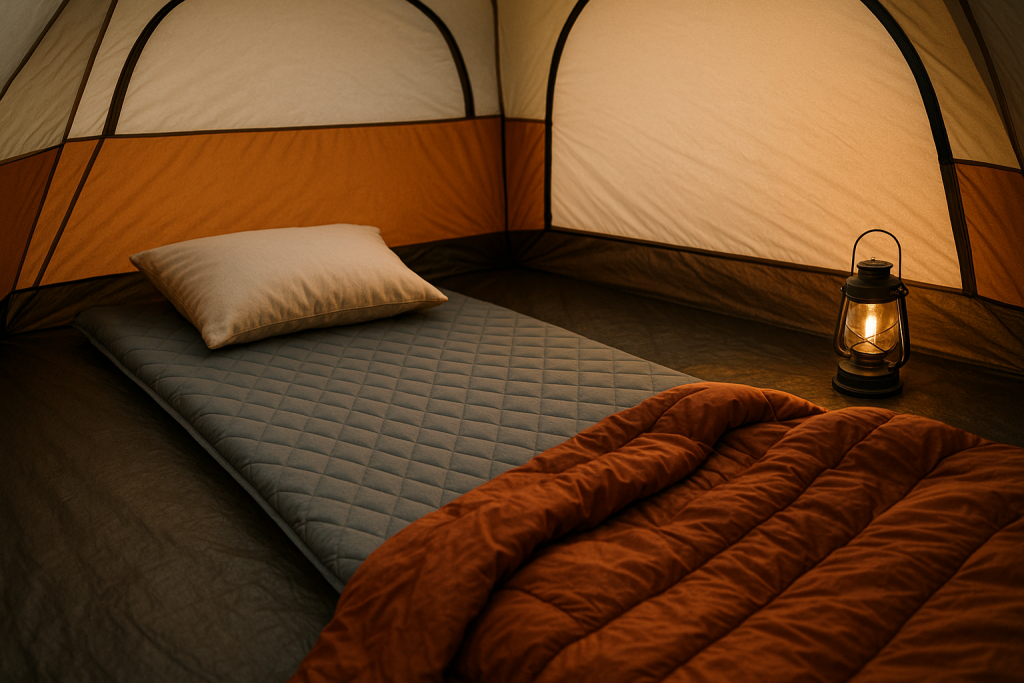
Self-inflating pads combine open-cell foam with air. Open the valve and the foam expands, drawing air inside; top off with a couple of breaths.
Pros
- Effortless setup—less huffing and puffing.
- Fails gracefully: even with a slow leak, foam still cushions.
- Stable feel—less trampoline, more “mattress.”
Cons
- Bulkier/heavier than most inflatables.
- Not usually as thick or plush at the same packed size.
Best for: Car campers, shoulder-season trips, folks who prefer stability over ultralight.
Inflatable vs. Self-Inflating: Key Differences
- Weight/Packability: Inflatable wins.
- Durability/Fail-Safe: Self-inflating wins (foam still helps).
- Feel: Inflatable = plush & tunable; Self-inflating = firm & steady.
- Setup: Self-inflating is faster; inflatable is more adjustable.
- Cold Protection: Either can be warm—check R-value, not marketing.
How R-Value Affects Your Sleep Outdoors
R-value is a pad’s thermal resistance—the higher it is, the warmer you’ll sleep. In practice, an R-value of ~2–3 suits summer, ~3–4 fits spring/fall, and 5+ is winter-friendly. R-values add when you stack pads (e.g., foam + inflatable). That’s why many cold-weather campers layer a thin foam pad underneath their main pad for both warmth and puncture protection.
Since 2022, many brands follow ASTM F3340, a standardized lab test that makes R-value comparisons more apples-to-apples (hot plate vs. cold plate under compression). Look for “ASTM R-value” in product specs to compare warmth reliably.
Thickness, Width, and Shape: Fit Comes First
- Side sleepers usually love 2.5–3.5 in. thickness for hip/shoulder relief.
- Back sleepers often prefer 2–3 in. with mild firmness for lumbar support.
- Wider pads (25–30 in.) reduce “arm fall-off” at night—worth the extra ounces.
- Mummy vs. rectangular: mummy saves weight; rectangular feels bed-like.
Ask yourself: Do I toss and turn? Sleep hot or cold? Need more width at the shoulders or hips? Let those answers drive your pick.
Noise, Texture, and Feel: The “Sleep Quiet” Factor
Crinkly fabrics or slick surfaces can keep you (or your tentmate) awake. If you’re a light sleeper, prioritize quieter pads and use a soft liner or thin blanket on top for a calm, non-slip feel.

Valve Types & Inflation Methods Explained
- Twist valves (classic): durable, familiar.
- High-flow one-way valves: quicker inflation/deflation.
- Pump sacks: save breath and add dry air (great in freezing temps).
- Micro-adjust buttons: let you tap out tiny puffs for perfect firmness.
Real-World Scenarios: Which Pad Fits Your Trip?
- Thru-hike or fast-pack: Go inflatable, low weight, mid-R-value (3–4).
- Family car camping: Self-inflating comfort with high R-value.
- Desert nights (big temp swings): Inflatable + pump sack for easy tuning.
- Winter basecamp: High-R inflatable + foam stacked for warmth and backup.
- Larger bodies: Consider wider/rectangular pads for shoulder and hip space.
Mistakes to Avoid with Camping Pads
- Overinflating (too stiff = pressure points).
- Skipping a groundsheet—tiny thorns can end a trip.
- Ignoring R-value and blaming your bag for cold nights.
- Not matching pad width to your shoulders/hips.
Care & Maintenance: Make Your Pad Last
- Sweep your tent site; clear pine needles and pebbles.
- Use a ground cloth beneath the tent’s floor.
- At home, store unrolled with valve open (for self-inflating foam health).
- Wipe with mild soap, not harsh solvents.
Field Repair: How to Patch an Inflatable Fast
- Find the leak (listen, then sponge soapy water and watch for bubbles).
- Dry thoroughly.
- Apply alcohol wipe, then stick a backcountry patch; press hard.
- Let cure as directed before reinflating.
Pro tip: carry a backup foam sit-pad—insulation + emergency backup under hips/torso.
The 5 Best Amazon Picks (Back-Friendly & Trail-Proven)
Therm-a-Rest NeoAir Xlite NXT (Inflatable)
Short take: Ultralight icon with real warmth for its weight.
Features: Triangular Core Matrix™, ASTM-rated R-value, compact pack size.
Pros: Very warm-to-weight, fine-tunable firmness, packs to a bottle.
Cons: Pricey; can sound slightly “papery” on some tents.
Best for: Long miles, shoulder-season backpacking.
Reviews say: Consistently praised for warmth and comfort relative to ounces.
NEMO Tensor Ultralight Insulated (Inflatable)
Short take: Cushy without the crinkle—sleep-quiet champ.
Features: Spaceframe™ baffles, pump sack included, ASTM R-value.
Pros: Stable, quiet fabric, easy micro-adjust.
Cons: Premium price; watch campsite debris like any inflatable.
Best for: Light sleepers, ultralight setups with plush feel.
Reviews say: “Hotel-like” comfort for an inflatable—especially for side sleepers.
Klymit Static V2 (Inflatable, Budget)
Short take: Wallet-friendly pad that still supports your back.
Features: V-chamber body-mapping, quick inflation.
Pros: Affordable, supportive channels, beginner-friendly.
Cons: R-value best for mild temps; add foam in colder months.
Best for: New backpackers, budget kits, warm-weather trips.
Reviews say: Great comfort per dollar; easy learning curve for new campers.
Therm-a-Rest ProLite Plus (Self-Inflating)
Short take: Foam-backed reliability that won’t quit mid-trip.
Features: Self-inflating open-cell foam, compact for its class, ASTM R-value.
Pros: Stable sleep surface, quick setup, works even if partially deflated.
Cons: Heavier than ultralight inflatables; not “pillow-top” plush.
Best for: Mixed trips, folks who prefer firm/stable over bouncy.
Reviews say: “Set-and-forget” dependability and solid shoulder support.
Coleman Self-Inflating Camping Pad with Pillow (Self-Inflating, Value)
Short take: Easy comfort for car camping, with a simple attached pillow.
Features: Integrated foam, rugged fabric, roll-strap storage.
Pros: Affordable, fast setup, forgiving foam feel.
Cons: Bulky for backpacks; pillow is basic (bring your own if picky).
Best for: Family camping, festival weekends, guests in a pinch.
Reviews say: Comfortable and tough at a friendly price point.
Two More Worth a Look (Our “7”)
Sea to Summit Ether Light XT Insulated (Inflatable): Extra-thick, cloud-like feel for side sleepers who want room to sink without bottoming out.
Exped MegaMat 10 (Self-Inflating): The car-camping legend—near-bed comfort and toasty warmth for shoulder season and winter cabins.
Comparison Table: Specs at a Glance
| Product | Type | Weight* | Thickness | Best Use | Price Range |
| Therm-a-Rest NeoAir Xlite NXT | Inflatable | ~13 oz | 2.5 in | Ultralight backpacking | $$$ |
| NEMO Tensor Ultralight Insulated | Inflatable | ~15 oz | ~3.0 in | Quiet, plush UL setups | $$$ |
| Klymit Static V2 | Inflatable | ~16 oz | 2.5 in | Budget backpacking | $$ |
| Therm-a-Rest ProLite Plus | Self-Inflating | ~20–23 oz | ~1.5 in | Firm/stable comfort | $$ |
| Coleman Self-Inflating w/ Pillow | Self-Inflating | Car-camp bulk | ~2–3 in (overall) | Car/family camping | $ |
| *weights vary by size (S/M/L/Rectangular/Wide). |
How to Choose: A Quick Decision Flow
- I carry my home on my back. → Inflatable, R-value 3–4, ~2.5–3 in thick.
- I want bed-like stability. → Self-inflating, higher R, rectangular/wide.
- I sleep cold. → Prioritize R-value 4–5+ (or stack pads).
- I’m on a budget. → Klymit Static V2 + thin foam underlay in shoulder season.
- I have broad shoulders or side-sleep. → Go wide and at least 2.5–3 in.

Research-Backed Insights on Comfort & Warmth
Study #1 – Sleep surface & back pain:
In a landmark clinical trial on medium-firm bedding, researchers found that switching to more supportive sleep surfaces significantly reduced back pain, stiffness, and poor sleep quality in adults. For campers, that means your pad’s firmness and stability aren’t just about comfort—they directly influence how your back feels in the morning.
Study #2 – Warmth & thermal resistance outdoors:
As REI explains in their expert breakdown of R-values, a pad’s ability to resist heat loss is just as critical as cushioning. Higher R-values mean warmer sleep, and layering two pads actually stacks their insulation values. Since 2020, the ASTM F3340 standard for sleeping pads has given outdoor brands a consistent test method, making cross-brand warmth comparisons more reliable.
Key takeaway: A supportive surface + the right insulation = the winning combo. Your back gets the stability it craves, and your body stays warm enough to rest deeply through the night.
FAQs: Answers to Common Questions
Are camping pads and air mattresses the same thing?
No. Camping pads prioritize insulation (R-value), packability, and support for outdoor ground conditions. Air mattresses are larger, heavier, and better for home/vehicle use.
What R-value do I need?
Summer: ~2–3. Spring/Fall: ~3–4. Winter or cold sleepers: 5+ or layer two pads to add their R-values.
Can I stack pads for more warmth?
Yes—R-values add. A foam pad under an inflatable boosts warmth and protects against punctures.
How do I prevent punctures?
Use a groundsheet, clear your tent site, and keep pets’ claws off the pad. Keep a patch kit on hand and be familiar with its usage.
Which pad is better for back pain?
There’s no one “best” for everyone, but most sore backs prefer stable support (often self-inflating) or a wider, thicker inflatable that you can fine-tune. The key is firm, even support—not squishy collapse.
Helpful Resource for Your Campsite Setup
Want shade and extra living space dialed in too? Explore this practical guide to choosing the right camper awning for your setup. It pairs perfectly with a good pad and chair for stress-free basecamps: camper awning ideas and options.
Conclusion: Sleep Better, Adventure Further
Outdoors, your pad is more than gear—it’s recovery. If you love ultralight miles and custom feel, go inflatable and tune it perfectly. If you want dependable stability and a backup plan if something leaks, go self-inflating and rest easy. Pick the thickness and R-value that match your body and your season, and you’ll wake up with energy to spare, ready to chase sunrises, ridgelines, and whatever wild thing tomorrow brings.