Camper Awning vs Canopy: Which One Should You Buy?
We may earn a commission for purchases made using our links. Please see our disclosure to learn more.
You pull into camp, swing open the RV door, and—boom—sun straight to the face. Or rain, sideways. If you’ve ever balanced a frying pan under a tree branch while your family huddled indoors, you already know: shade isn’t a luxury—it’s sanity. The big question is what kind of shade has your back: a built-in camper awning or a freestanding canopy?
In this friendly (but practical) guide, we’ll unpack the real-world differences, help you map your camping style to the right choice, and share five Amazon product picks that won’t let you down. By the end, you’ll know exactly what to buy—and why.
What’s the Real Difference?
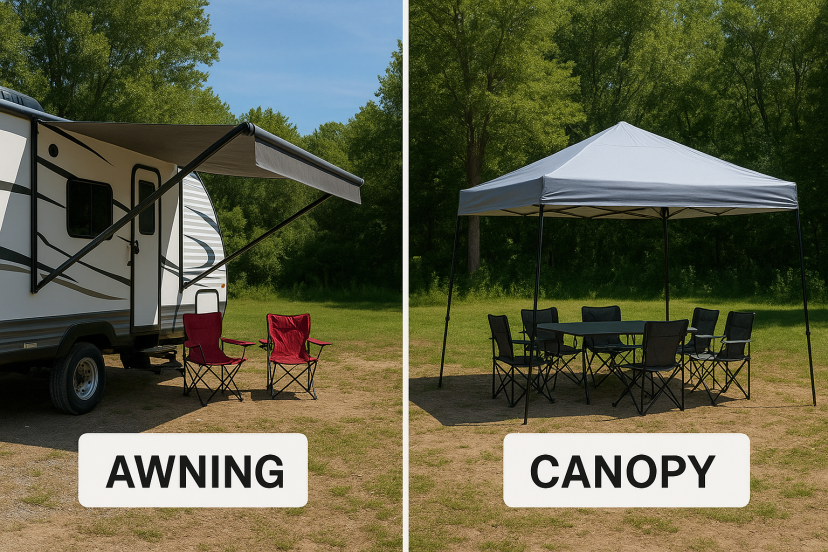
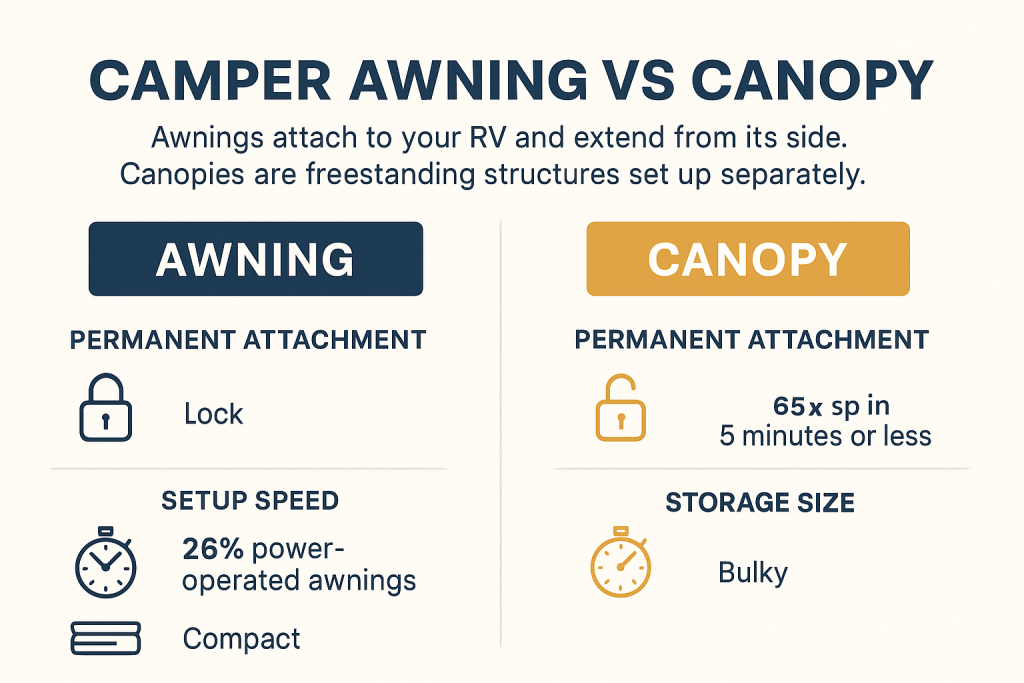
A camper awning mounts to your RV/trailer and rolls out in seconds. A canopy is a portable, stand-alone shelter you pitch wherever you need it—by the picnic table, at the beach, or over your outdoor kitchen.
Quick Buyer’s Summary (TL;DR)
- Choose a camper awning if you want instant, attached shade with minimal fuss at your door.
- Choose a canopy if you want flexible shade anywhere—tailgates, parks, beaches, second seating zones.
- Road warriors often keep both: awning for daily living; canopy for overflow, group meals, or gear staging.
When a Camper Awning Shines
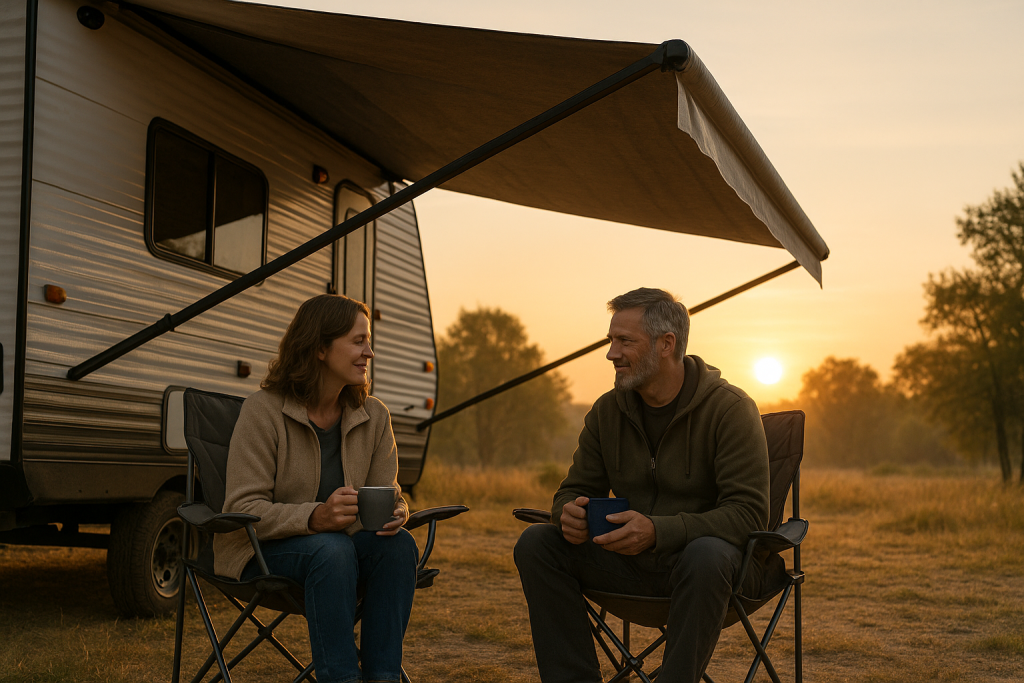
Awnings feel like adding a front porch to your camper. You roll out coverage where you step out—perfect for coffee mornings and late-night listening to crickets.
Why it’s lovely
- Always with you: no extra bags or poles to cram into the trunk.
- Fast setup: power awnings deploy with a button; manuals are still quick.
- Cohesive look: your outdoor “room” feels connected to the rig.
Where it struggles
- Fixed location: shade is only where your RV is parked.
- Repair costs: fabric/arms/motors can be pricier to fix than a canopy.
- Size limit: coverage is tied to your rig and hardware.
When a Canopy Makes More Sense
Think of a canopy as your pop-up living room. You can move it to the best patch of shade, angle it for a sunset, or set it over a communal table.
Why it’s great
- Go-anywhere flexibility: camp, beach, tailgate, kids’ games.
- Larger footprints: 10×10 and 12×12 are common.
- Price flexibility: wide range from budget to commercial-grade.
Watch-outs
- Setup time & bulk: legs, top, stakes, bag—there’s more to haul.
- Wind management: needs weight and guy lines when breezy.
Space, Weight & Storage: What You’ll Actually Carry
- Awning: zero extra cargo; it’s bolted to the rig.
- Canopy: expect a long, wheeled bag (think 40–60 inches). If you have a small SUV or are already gear-heavy, measure first.
- Pro tip: if you travel solo or have mobility constraints, practice pitching your canopy at home. Trust me, your back and shoulders will be glad you did.
Weather Performance: Sun, Wind & Rain
- Awnings excel for fast shade and light rain. Add drop-down legs, rafters, or side panels for more stability and splash protection.
- Canopies can be fantastic in sun and drizzles, especially with sidewalls or sunwalls. In wind, weight each leg and use guy lines; if gusts kick up, take it down before fabric or frames get stressed.
Setup & Takedown: How Much Work?
- Awnings: power = push button; manual = a few latches/poles.
- Canopies: instant frames are quick (one or two people), but you’ll still stake/weight, tension the top, and add walls if needed. Think “5–10 minutes” once you know the dance.
Durability & Materials: What Matters
- Fabric: look for thicker polyester/oxford with UV treatment; UPF-rated materials block more sun.
- Frame: powder-coated steel (stronger/heavier) vs aluminum (lighter/less rust-prone).
- Stitching & seams: reinforced corners and taped seams last longer in rain and wind.
Safety & Anchoring Tips
- Always stake and weight (sandbags, water weights, or plates) even on calm days—the breeze arrives uninvited.
- Angle one side slightly lower in rain so water doesn’t pool.
- Retract awnings if you leave camp or winds pick up; it’s cheaper to redeploy than to replace bent arms.
Budget: What You’ll Likely Spend
- Awning upgrades/replacements: fabric-only swaps are budget-friendly; full hardware kits (arms, roller, fabric) cost more but feel brand-new.
- Canopies: range from affordable weekenders to commercial frames that shrug off years of use.
Real-Life Scenarios: Which One Wins?
- Quick coffee porch at sunrise? Awning.
- Shade for six at the picnic table? Canopy.
- Beach day away from camp? Canopy.
- Thunderhead rolling in while you’re cooking? Either—awning for speed, canopy with sidewalls for a drier “room.”
- You love minimal gear? Awning.
- You host potlucks or travel with friends? Canopy (and maybe both).
Maintenance & Care Checklist
- After rain: dry fabric before storage to avoid mildew.
- Seasonally: check bolts, pins, and small hardware.
- Wind rules: when in doubt, take it down or retract.
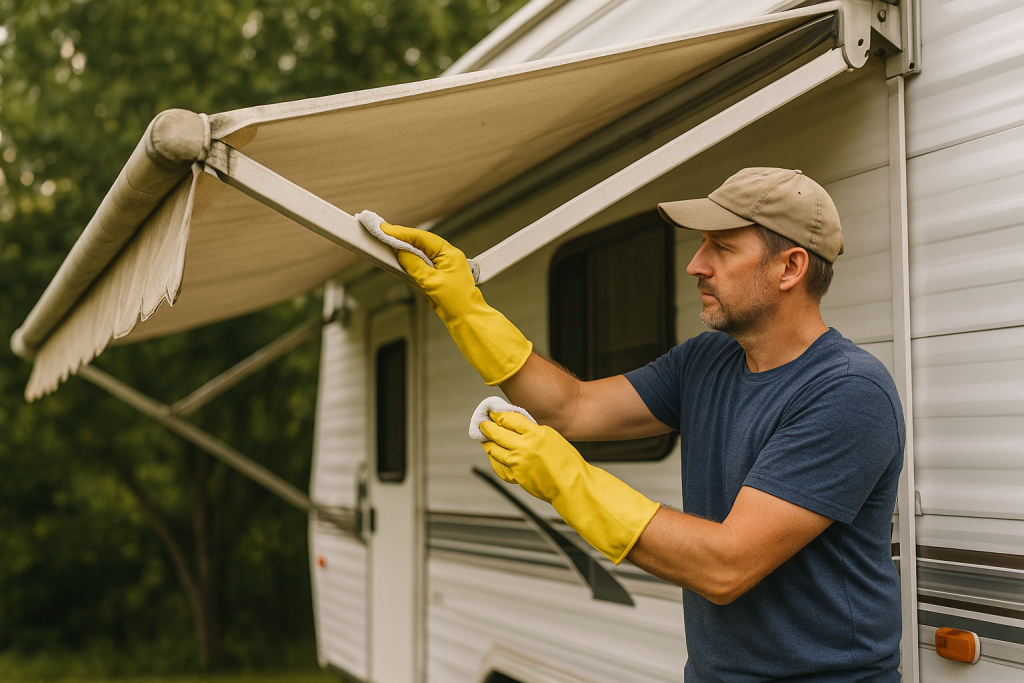
- Cleaning: mild soap, soft brush; avoid harsh solvents that degrade coatings.
Common Mistakes to Avoid
- Leaving awnings/canopies up overnight in gusty areas.
- Under-weighting canopy legs (or forgetting stakes).
- Pooling water because the roof is perfectly flat—tilt one side.
- Skipping a practice setup at home, then wrestling fabric at sunset.
🔹 Recommended Camper Awning & Canopy Picks
1) Solera RV Awning Replacement Fabric
A trusted replacement fabric for worn-out RV awnings.
- Features: Heavy-duty vinyl, heat-welded seams, multiple sizes & colors
- Pros: Affordable refresh, UV & weather-resistant
- Cons: Fabric only (hardware not included)
- Best For: RV owners with solid hardware who just need new fabric
- Reviews: ⭐⭐⭐⭐ 4.4/5 (500+ ratings)
2. ARB Deluxe Awning Room with Floor 2000×2500
- Features: Comes with integrated floor, full enclosure sidewalls, built for robust weather conditions
- Pros: Roomy add-on space, excellent protection from wind and rain, integrates nicely with existing awning setups
- Cons: Heavier and more bulky to transport
- Best Use Case: For campers who already have an awning and want a “room” extension to expand covered living area
- Reviews: 5.0/5 (4 reviews)
3) ABCCANOPY 10×10 Pop-Up Canopy
A budget-friendly, easy-to-use pop-up canopy for campers and tailgaters.
- Features: Instant frame setup, multiple height settings, wheeled bag
- Pros: Fast pitch, portable, lots of color choices
- Cons: Needs weights in windy conditions
- Best For: Families, tailgates, and extra shaded hangout space
- Reviews: ⭐⭐⭐⭐ 4.5/5 (30,000+ ratings)
4) Eurmax USA 10×10 Commercial Pop-Up Canopy (with Sidewalls)
A heavier-duty canopy that includes privacy and weather sidewalls.
- Features: Durable frame, waterproof 300D fabric, removable sidewalls
- Pros: Strong, versatile, excellent for varied weather
- Cons: Bulkier and heavier than budget models
- Best For: Long stays, windy or rainy destinations
- Reviews: ⭐⭐⭐⭐ 4.6/5 (22,000+ ratings)
5) Coleman 10×10 Instant Canopy with Sunwall
A classic Coleman canopy with a detachable sunwall for angled sun.
- Features: Lightweight frame, included sunwall panel
- Pros: Quick setup, portable, reliable brand
- Cons: Smaller coverage compared to 12×12 models
- Best For: Couples, light camping, or quick shade at the park/beach
- Reviews: ⭐⭐⭐⭐ 4.5/5 (9,000+ ratings)
Head-to-Head Comparison Table
| Product | Type | Key Feature | Pros | Cons | Best For |
|---|---|---|---|---|---|
| Lippert Solera Fabric | RV Awning (fabric) | Heavy-duty vinyl replacement | Affordable, durable, weather-resistant | Needs existing hardware | RV owners refreshing worn awning fabric |
| ARB Deluxe Awning Room with Floor | Awning Add-On | Full enclosure w/ floor & walls | Extra living space, great weather protection | Bulky, requires existing awning | Campers wanting an enclosed “room” extension |
| ABCCANOPY 10×10 | Canopy | Pop-up design, wheeled bag | Portable, quick setup, budget-friendly | Wind-sensitive | Families, tailgates, general shade |
| Eurmax USA 10×10 | Canopy (with sidewalls) | Commercial frame + removable walls | Versatile, waterproof, stable | Heavier, bulkier | Longer stays, rainy or windy destinations |
| Coleman 10×10 w/ Sunwall | Canopy (with sunwall) | Sun-block wall panel | Lightweight, trusted brand, easy setup | Smaller footprint | Couples, beach/park day trips |
Reflective Questions to Dial in Your Choice
- Do you prefer speed or flexibility?
- Will you host bigger groups or keep it cozy for two?
- Are you comfortable hauling a long, wheeled bag?
- Do you often hang at the beach/park away from camp?
- Will you camp in wind-prone areas where weight matters?
A Quick Story From the Road
On a sticky August weekend, we parked beneath a postcard-blue sky that turned moody by dinnertime. The awning saved the burgers from a soggy ending, but our friends? They were huddled by the picnic table 20 feet away. Enter the canopy: we pitched it over the table, clipped on a sunwall to block the sideways sprinkles, and the night turned into a cozy, lantern-lit hangout. Moral: if you host, a canopy is the social glue; the camper awning is your daily porch.
Style & Comfort Across Cultures
From Mediterranean siestas to Southeast Asian street markets, shade is culture, not just comfort. The setup changes—the awning as your porch, the canopy as your plaza—but the goal is the same: make outside livable. Whether you’re on a sandy beach in Cebu or tucked among red rock mesas, shade transforms the space into someplace you want to be.
What science says about shade and comfort
A year-long field study in Tempe, Arizona compared different shade types (including tree shade and photovoltaic canopies) and tracked weather plus how people felt outdoors. The researchers found that shade plays a pivotal role in improving outdoor thermal comfort, with participants experiencing noticeably more pleasant conditions under canopies and trees than in direct sun. The takeaway: thoughtful shade isn’t just psychological—it measurably changes the heat your body perceives and can keep you outside longer. That’s exactly what you want from an awning or canopy at camp.
What dermatology research says about UV protection
Peer-reviewed dermatology reviews show that not all shade is equal: deeper shade with less visible sky (think roofs, dense foliage, or high-UPF shade sails) provides markedly better UV protection than open, airy shade. Materials and design details—like sidewalls, roof coverage, and fabric UPF—significantly affect how much ultraviolet radiation reaches your skin. Translation for campers: a canopy with sidewalls or an awning plus drop-down panels can help reduce UV exposure more than open shade alone, especially when ground reflections are strong (beach, snow, pale rock).
FAQs (Quick, Snippet-Friendly)
Is a camper awning worth it?
Yes—if you want instant, attached shade for everyday camp life. It’s fast, convenient, and boosts livability right at your door.
Can I use a canopy and awning together?
Absolutely. Many campers use the awning for the porch and a canopy for dining or group hangouts, especially when the table isn’t near the rig.
Which is better in wind?
Awnings are stable when properly set and retracted during gusts. Canopies do well, too—if you stake and weight each leg and use guy lines. When wind spikes, take either one down.
Do UPF fabrics really matter?
Yes. UPF-treated or tightly woven fabrics reduce UV exposure, and shade designs with fewer open sides help even more.
What size canopy should I get?
For couples/small families, 10×10 hits a sweet spot of coverage vs. portability. Larger groups may prefer 12×12 or screen-room gazebos.
Helpful Trip-Planning Resource
Level up your next outing with this practical guide to family camping tips and ideas — it’s packed with checklists, advice, and inspiration to make your outdoor adventures smoother and more enjoyable.
Final Verdict (Friendly but Firm)
If your top priority is speed and simplicity, go with a camper awning—it’s your porch, always ready. If you crave flexibility and host meals away from the rig (beach days, park hangs, tailgates), add a canopy. And if camping is how you connect—with nature, with people, with your best self—there’s no rule saying you can’t have both. Build the shade that supports the memories you want to make.