5 Eco-Friendly Camping Gear Essentials
We may earn a commission for purchases made using our links. Please see our disclosure to learn more.
Camping should leave you with muddy boots, good stories, and perhaps one mysteriously missing tent peg—not a pile of disposable bottles, dead batteries, and broken equipment. Yet “green” gear can be difficult to judge because vague labels rarely explain whether a product will actually reduce waste.
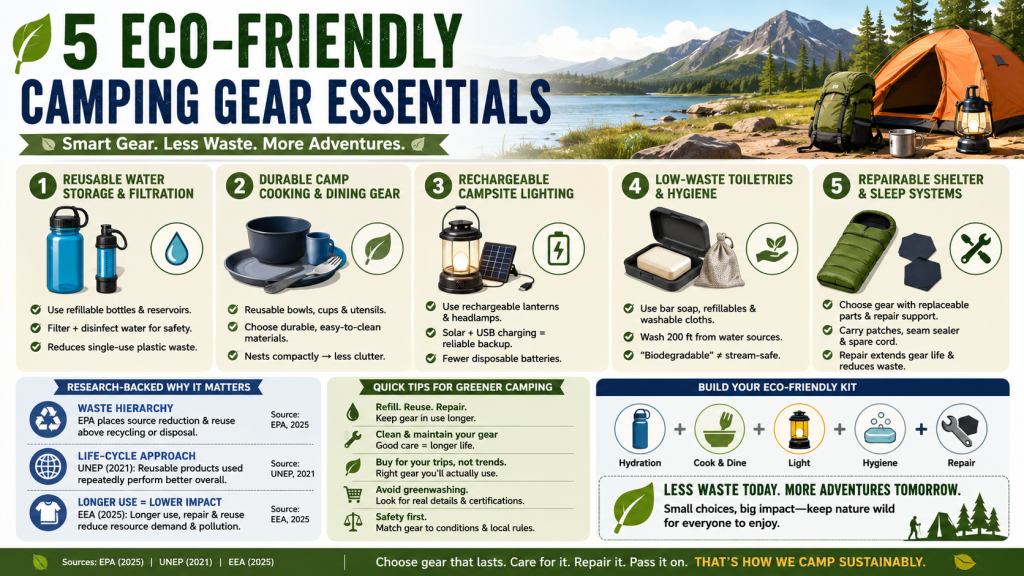
This guide covers five Eco-Friendly Camping Gear Essentials for family campgrounds, road trips, festivals, and backcountry weekends. You will learn when to keep using what you own, which materials and features matter, and which products suit different camping styles. The goal is not a flawless matching kit. It is a dependable setup you can refill, recharge, repair, and take outside for years.
Affiliate disclosure: This article may contain affiliate links. If you purchase through them, the website may earn a commission at no extra cost to you.
Why Eco-Friendly Camping Gear Essentials Matter
Outdoor equipment carries an environmental footprint before it reaches camp. Materials are extracted, processed, assembled, packaged, and transported, while broken gear may be difficult to repair or recycle.
Useful Eco-Friendly Camping Gear Essentials replace disposables, survive frequent use, or offer repairable parts. They also simplify camp: rechargeable lights prevent battery emergencies, nesting dishes reduce clutter, and patches can rescue a torn jacket.
Start With the Gear You Already Own
Before shopping, sort equipment into usable, repairable, and unsuitable groups. A faded backpack, scratched mug, or older sleeping bag may still work well. Clean it, replace a buckle, patch a tear, or borrow occasional-use gear.
Upgrade when an item creates repeated waste, poses a safety concern, or no longer fits your trips. Eco-Friendly Camping Gear Essentials should solve a real problem—not replace dependable gear for a newer color.
Essential 1: Reusable Water Storage and Filtration
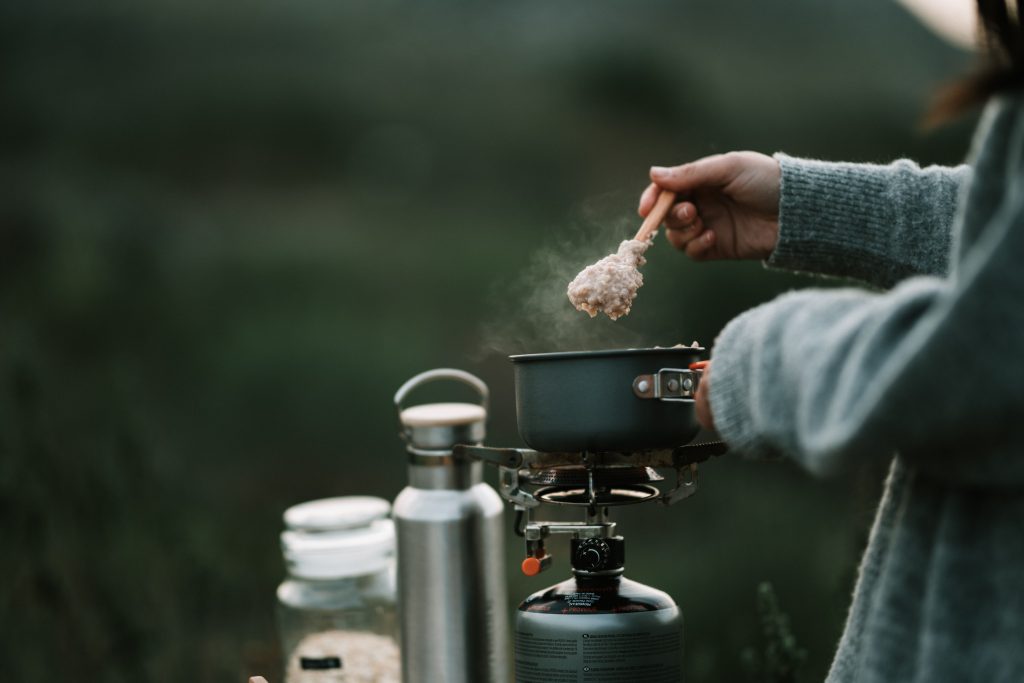
Choose a reusable bottle or reservoir with a practical capacity, leak-resistant lid, and easy-clean opening. Its environmental value grows through repeated use.
For backcountry water, select treatment based on local risks. The CDC’s 2025 camping-water guidance notes that clear water may still contain germs. It recommends boiling when possible or filtering and then disinfecting. Check each filter’s limitations; many do not remove viruses, harmful chemicals, or every contaminant.
Essential 2: Durable Camp Cooking and Dining Gear
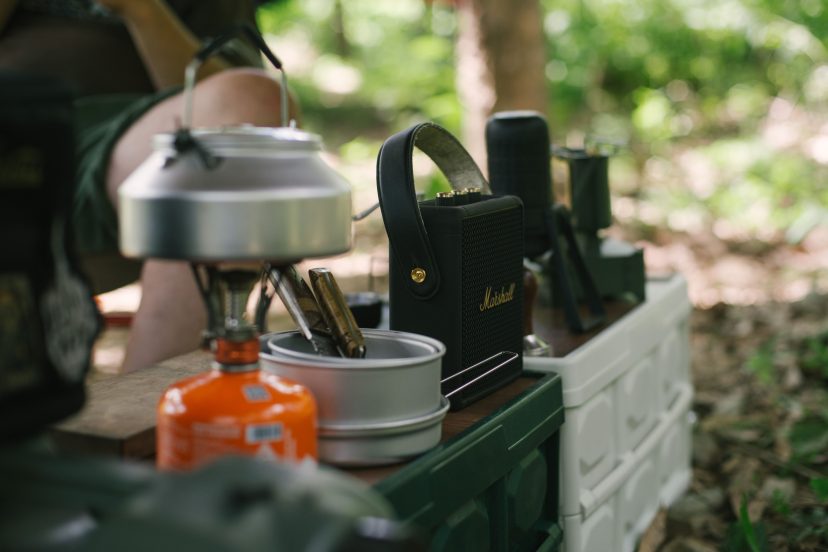
A reusable bowl, cup, and utensil set replaces disposable plates and cutlery. Look for pieces that nest, clean easily, and have few tiny parts to lose.
Car campers may prefer stainless steel, while backpackers often choose lighter polypropylene, aluminum, or titanium. Select materials for your cooking method and carrying distance. Among Eco-Friendly Camping Gear Essentials, durable dining gear also works for picnics, packed lunches, and road trips.
Essential 3: Rechargeable Campsite Lighting
Rechargeable lanterns and headlamps reduce disposable-battery use. Compare runtime, charging method, water resistance, and whether the battery or cable can be replaced.
Clouds, shade, panel size, and season affect solar charging. A lantern with solar and USB input offers a backup. One area lantern and one headlamp usually cover more situations than several overlapping gadgets, making lighting one of the most practical Eco-Friendly Camping Gear Essentials.
Essential 4: Low-Waste Toiletries and Hygiene
Replace miniature toiletry bottles with bar soap, concentrated products, refillable containers, and washable cloths. Unscented options are generally easier to manage in wildlife country, although every scented item should follow local storage rules.
“Biodegradable” does not mean stream-safe. National Park Service guidance recommends washing at least 200 feet from natural water sources and using only a small amount of biodegradable soap. Local rules may be stricter. A breathable soap pouch can reduce packaging, but let a dripping bar drain briefly before packing it.
Essential 5: Repairable Shelter and Sleep Systems
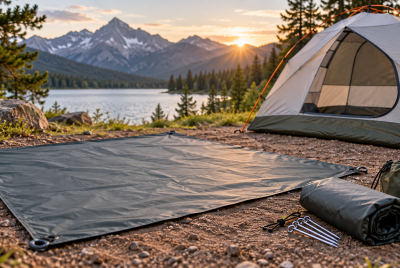
Tents, sleeping bags, pads, and rain shells use substantial material, so keeping them functional matters. Check for replacement poles, valves, buckles, zipper parts, repair instructions, and warranty support.
Carry patches, suitable seam sealer, spare cord, and a few cable ties. Match adhesives to the fabric because standard patches may not bond to silicone-treated nylon. Eco-Friendly Camping Gear Essentials should fit your weather and comfort needs; unsuitable ultralight gear rarely stays in use for long.
How to Judge Materials, Durability, and Certifications
Recycled content, stainless steel, and plant-based materials are useful signals, not proof. Ask whether the item can be cleaned, repaired, refilled, and used frequently. Check replacement parts and local recycling options.
Third-party certifications are more informative than homemade green badges, although their scope varies. A standard may cover recycled inputs, forestry, chemicals, labor, or factory processes rather than the entire product life cycle. The strongest Eco-Friendly Camping Gear Essentials combine credible details with long-term usefulness.
Match Eco-Friendly Camping Gear Essentials to Your Trip
Car campers can prioritize sturdy cookware, larger water containers, and area lighting. Backpackers benefit from compact filters, multipurpose dishes, and lightweight repair supplies.
Families may need leak-resistant lids and easy-clean surfaces. Festival campers often prioritize hydration and lighting. Cold-weather campers should put insulation and weather protection first; environmental goals never justify unsafe equipment.
Write down your trip type, group size, water access, likely weather, and cooking plan. Then buy only the Eco-Friendly Camping Gear Essentials that answer those needs.
Recommended Eco-Friendly Camping Gear Essentials
These six products serve a lower-waste camping kit. Each recommendation includes a limitation because honest gear advice should cover the small catches too.
| Product | Best use | Standout feature | Limitation |
| Nalgene Sustain 32 oz Wide Mouth | Everyday hydration | Material derived from 50% plastic waste | Wide opening may splash |
| LifeStraw Peak Series 1L | Backcountry filtration | Collapsible filter bottle | Not for every contaminant |
| UCO 6-Piece Mess Kit | Reusable camp meals | Compact nesting set | Not a cookset |
| Luci Outdoor 2.0 | Off-grid lighting | Solar and USB-C charging | Sunlight affects charging |
| Matador FlatPak Soap Bar Case | Low-waste toiletries | Dry-Through construction | Very wet soap dries slowly |
| GEAR AID Tenacious Tape Hex Patches | Field repairs | No-sew technical-fabric patches | Poor fit for silicone fabrics |
Nalgene Sustain Tritan BPA-Free Water Bottle Made with Material Derived from 50% Plastic Waste, 32 OZ, Wide Mouth, Aubergine
Best for: Everyday campers wanting a durable refillable bottle
Made with material derived from 50% plastic waste through an ISCC-certified mass-balance approach, this BPA/BPS-free bottle is dishwasher safe and fits many filtration devices. Its broad mouth simplifies cleaning and adding ice, although drinking while walking can produce the occasional shirt-soaking surprise.
LifeStraw Peak Series Collapsible Squeeze Bottle Water Filter System, 1L, Mountain Blue
Best for: Backpackers needing compact water treatment
The 1-liter collapsible system uses a 0.2-micron membrane microfilter rated for up to 2,000 liters. LifeStraw says it meets EPA and NSF P231 standards for bacteria and parasite removal. However, it does not remove viruses or heavy metals, so match it carefully to your route.
UCO 6-Piece Camping Mess Kit with Bowl, Plate, Camp Cup, Switch Spork, and Tether, Blue
Best for: Campers wanting an organized reusable dining set
This kit nests a bowl, lid or plate, collapsible cup, two-piece Switch Spork, and tether in one package. The rounded shape helps scoop food cleanly, while the tether keeps loose pieces together. It handles eating and storage, but you still need separate stove-safe cookware.
MPOWERD Luci Outdoor 2.0 Solar Inflatable Lantern, Rechargeable via Solar or USB-C, 75 Lumens, Clear
Best for: Campers wanting lightweight rechargeable area lighting
This inflatable lantern delivers up to 75 lumens, offers four lighting modes, and charges through solar power or USB-C. The current version is rated IP67 and collapses for transport. Solar charging adds off-grid flexibility, although it works best with several hours of sunlight.
Matador FlatPak Soap Bar Case, Charcoal
Best for: Minimalists replacing travel-size toiletry bottles
The flexible case uses welded construction and Dry-Through material, allowing a damp soap bar to lose moisture while contained. Its roll-top closure becomes more compact as the bar shrinks. It controls mess well, but very wet soap benefits from a brief air-dry before packing.
GEAR AID Tenacious Tape Hex Repair Patches, Clear, 2.5-Inch and 1.5-Inch, 4 Pack
Best for: Campers building a lightweight repair kit
These peel-and-stick patches attach to nylon, polyester, vinyl, and many technical fabrics without sewing or heat. They become washable after bonding for 24 hours and suit small tears in tents, jackets, packs, or sleeping bags. Standard versions may not adhere properly to silicone-treated fabrics.
Research-Backed Reasons to Reuse and Repair
The evidence supports a simple order: prevent waste, reuse, repair, and then recycle what remains. The U.S. Environmental Protection Agency’s materials-management hierarchy, updated in 2025, ranks source reduction and reuse above recycling because avoiding a new item also avoids some manufacturing and transport impacts.
A 2021 United Nations Environment Programme life-cycle review concluded that disposable design can be more problematic than plastic itself and that well-used reusables generally perform better.
The European Environment Agency reported in 2025 that longer use, repair, and reuse can reduce demand for raw materials and lower pollution. Results vary by material and usage, so not every reusable product is automatically greener. Still, the evidence favors durable equipment used repeatedly.
Care Habits That Extend Gear Life
After each trip, dry shelters fully, clean cookware, and maintain filters as directed. Store sleeping bags loosely and keep rechargeable devices within recommended temperature and charge ranges.
Before the next trip, inspect seams, valves, poles, cords, and zippers. Create a small repair box for loose buckles, spare caps, patches, and seam sealer. Maintenance is not glamorous, but neither is discovering mildew the night before departure. These habits help Eco-Friendly Camping Gear Essentials last longer.
Greenwashing Traps to Avoid
Treat words such as green, natural, and sustainable as prompts for questions, not proof. Watch for undisclosed plastics, vague biodegradable claims, and carbon-neutral claims built mostly on offsets.
Also, recyclable does not always mean locally recyclable. Coatings, mixed materials, and small components can prevent acceptance. Strong product pages provide measurable details, such as recycled-content percentages, named certifications, replaceable parts, repair services, or battery specifications. The most convincing Eco-Friendly Camping Gear Essentials explain both their strengths and their limitations.
Frequently Asked Questions About Eco-Friendly Camping Gear Essentials
What camping item should I replace first?
Replace the item creating the most repeated waste or frustration, such as disposable bottles, batteries, plates, or utensils. Do not discard functional equipment merely to buy a greener version. Keep what works, repair what you can, and upgrade when an item is unsafe, worn out, or genuinely unsuitable for your trips.
Is recycled plastic always better than virgin plastic?
Not automatically. Recycled content can reduce demand for virgin material, but durability, manufacturing, transport, and actual use still matter. A recycled bottle used twice and forgotten offers little benefit. Choose a design you will use repeatedly, maintain correctly, and replace only when it can no longer perform safely.
Are solar lanterns reliable for camping?
Yes, provided the lantern has adequate battery capacity and receives the recommended direct sunlight. Clouds, shade, winter days, and poor panel placement slow charging. A model that also charges through USB offers a useful backup. Fully charge it before departure, then use solar power to maintain the battery at camp.
Does biodegradable soap make washing in streams safe?
No. Biodegradable soap should not enter lakes, rivers, or streams. Carry washing water away from natural sources, use a small amount, strain food particles, and follow the land manager’s disposal rules. The term describes breakdown under certain conditions; it does not make soap harmless to aquatic environments.
How many Eco-Friendly Camping Gear Essentials do I need?
Five categories cover most beginners: reusable hydration, durable dining gear, rechargeable lighting, low-waste hygiene, and repair supplies. You do not need to purchase everything at once. Start with the category replacing the most disposable items, then add equipment gradually as your camping habits become clearer.
Final Recommendation: Build Your Kit One Upgrade at a Time
The best Eco-Friendly Camping Gear Essentials are products you will use often, maintain properly, and trust when conditions change. Begin with your current kit, repair what still has life, and replace only genuine weak points.
For campground trips, the Nalgene Sustain bottle and UCO mess kit provide simple reusable foundations. Backpackers may gain more from the LifeStraw Peak Series bottle and GEAR AID patches, while the Luci Outdoor 2.0 suits campers who want rechargeable lighting without loose batteries.
Choose for your trip type, verify safety-critical specifications, and favor repairable designs with clear material information. A lower-waste camping kit grows through sensible decisions—not one heroic shopping spree.